
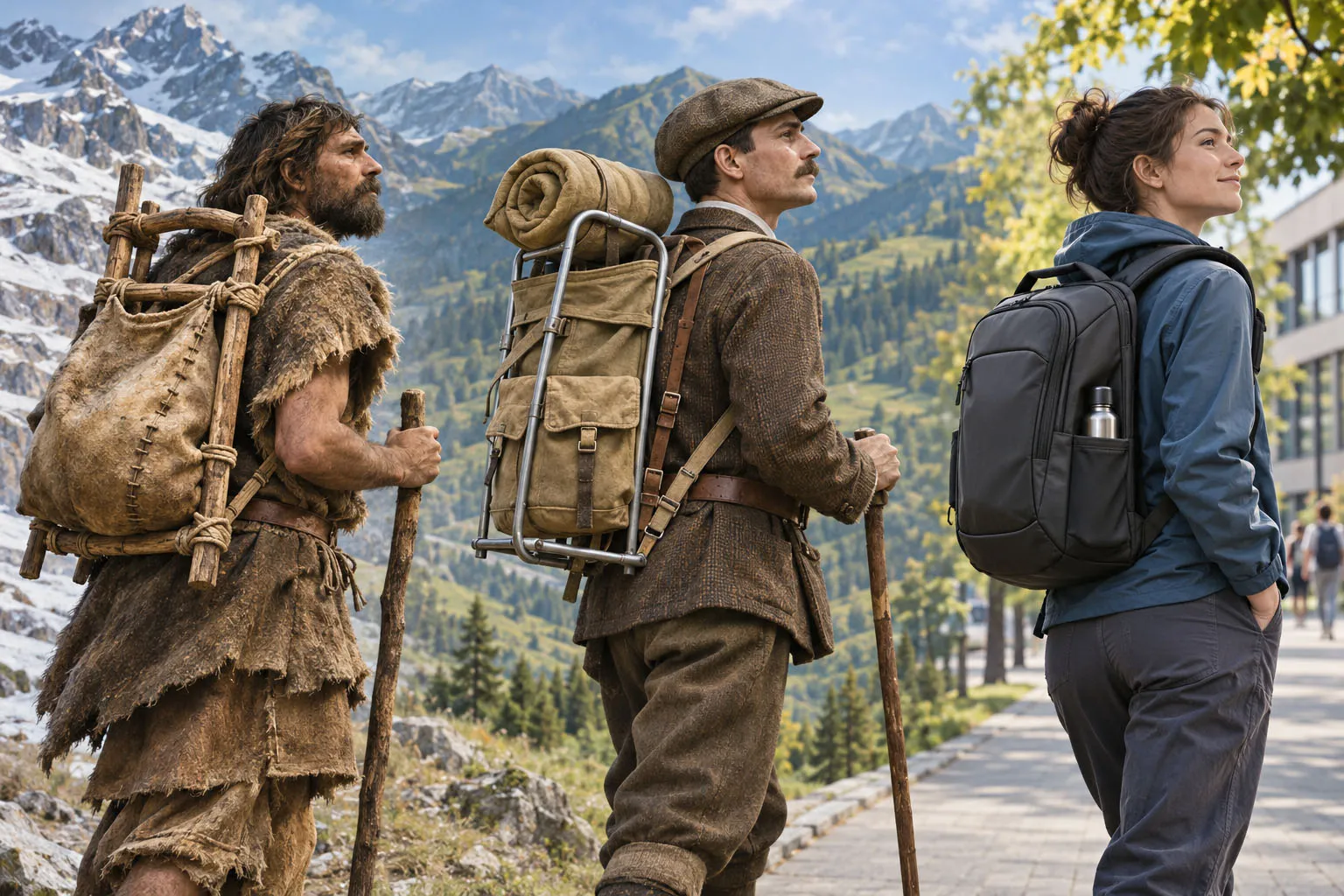
A backpack is a conversation between a body and a terrain. The body says: this load is heavy, this slope is steep, this back is sweating. The pack, at its best, answers.
Every strap, frame, zipper, padded panel, and buckle in a modern backpack is a response to an earlier problem — a chafed shoulder, an unstable load, inaccessible gear, or simply too much weight.
That is why the question “Who invented the backpack?” has no clean answer.
Nobody invented the backpack in a single moment. There is no lone inventor whose sketch explains the modern pack. Instead, backpack history is a chain of people solving different carrying problems over thousands of years.
Ötzi the Iceman carried provisions with a framed load carrier roughly 5,000 years ago. A U.S. Army officer patented a metal-framed knapsack in 1878. External frames became commercially important in the early 20th century. Internal frames, nylon fabrics, zippers, padded hipbelts, ventilation systems, and laptop compartments followed much later.
To understand who made the backpack, it helps to separate three things:
- Ancient load-carrying practices
- Patented backpack innovations
- Mass-market backpack adoption
The history of the backpack is therefore less about one inventor and more about which design solved which problem.
Why There Is No Single Inventor of the Backpack
Carrying loads on the back is older than written history.
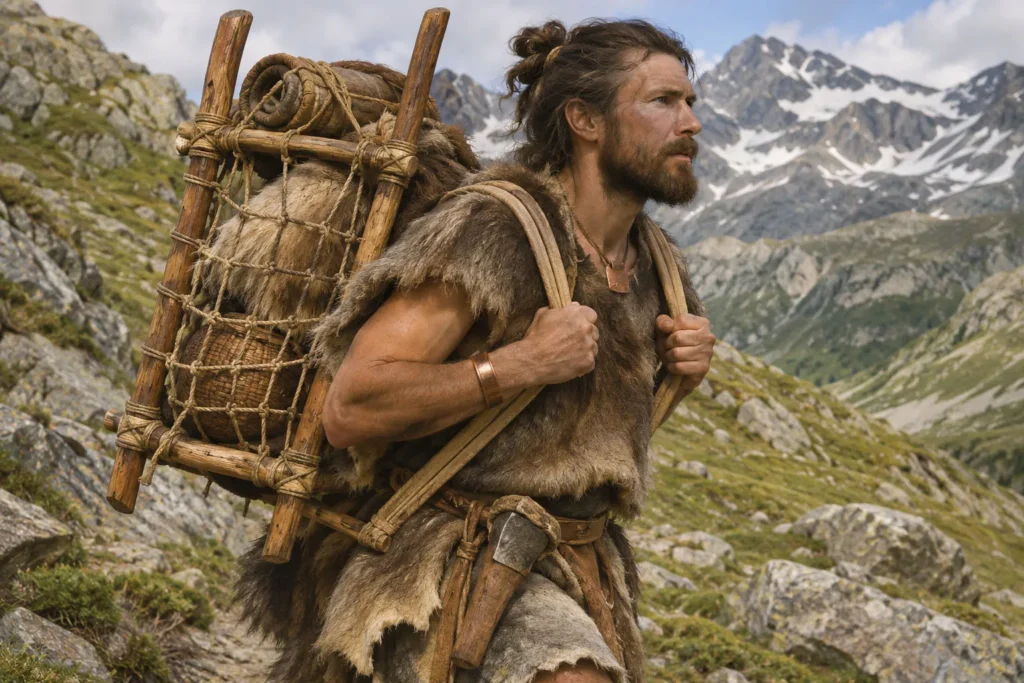
One of the earliest documented structured back carriers is associated with Ötzi the Iceman, who died around 3300 BC and was discovered in the Ötztal Alps in 1991.
According to the South Tyrol Museum of Archaeology, part of his equipment appears to have included a wooden carrying frame made from a bent hazel rod and narrow wooden boards. A hide sack or net could likely have been attached to the structure.
The basic idea is immediately recognizable even today: create a structure that holds a load securely against the body.
But that does not mean Ötzi “invented” the backpack.
Ancient carrying systems existed in many cultures and probably developed independently wherever people needed to transport food, tools, firewood, hunting equipment, or other supplies.
The modern backpack emerged much later through a series of documented design innovations.
One important example came in 1878, when U.S. Army officer Henry C. Merriam received a patent for a military knapsack using a sheet-metal frame, wooden braces, storage compartments, and a hip strap.
It was an ambitious attempt to improve how soldiers carried equipment.
It was not necessarily comfortable or commercially successful.
That distinction matters: the first patented solution is not always the solution that ultimately defines the product.
The Load-Transfer Problem: From Shoulders to Hips
One of the most important problems in backpack design has always been weight distribution.
A basic sack hanging from two shoulder straps places much of the load on the shoulders. Because the weight sits behind the body, the wearer often compensates by leaning forward.
That becomes uncomfortable during long periods of walking.
Early backpack designers therefore began experimenting with frames and braces that could hold the load closer to the body and distribute it more effectively.
In 1908, Norwegian inventor Ole F. Bergan reportedly improvised a support for his rucksack during a hunting trip by bending a juniper branch into a frame. He later developed a tubular steel-frame version and patented the design internationally.
Rigid external frames helped keep the load stable and separated the pack from the wearer’s back.
But stability alone did not solve everything.
The next major improvement was transferring more weight toward the hips.
Dick and Nena Kelty began producing handcrafted backpacks in the early 1950s, introducing improvements such as padded shoulder straps and waistbelts. Later hipbelt systems became increasingly effective at moving weight away from the shoulders and onto the pelvis.
That principle remains central to modern hiking, trekking, and travel backpack design.
A well-designed pack can therefore feel more comfortable not simply because it weighs less, but because the load is carried by stronger parts of the body.
Materials, Zippers and Ergonomics Changed the Backpack
Frames solved one major problem, but modern backpack design also evolved through a series of smaller innovations.
Each solved a particular complaint.
Lighter Materials
Early backpacks relied heavily on canvas and leather.
These materials were strong, but they could also be relatively heavy, especially when wet.
Synthetic fabrics changed that.
By the 1960s, nylon began appearing in lightweight outdoor packs. Nylon offered a useful combination of low weight, strength, abrasion resistance, and faster drying compared with many traditional fabrics.
Today, backpack materials extend far beyond basic nylon.
Manufacturers commonly work with polyester, nylon, canvas, ripstop fabrics, recycled polyester, coated textiles, PU, PVC, TPU laminates, mesh, foam, and reinforcement materials.
If you want a detailed breakdown of how these components work together, see What Is a Backpack Made Of? A Guide to Backpack Materials.
Easier Access
Early packs often relied on straps, buckles, flaps, and drawstring closures.
Zippers changed the way users interacted with a backpack.
Instead of opening a large top compartment and unloading gear to reach something buried inside, designers could create separate zippered pockets and access points.
That idea eventually became fundamental to everyday backpack design.
Modern backpacks may include:
- Main zippered compartments
- Front organizer pockets
- Side-access compartments
- Hidden security pockets
- Laptop sleeves
- Shoe compartments
- Quick-access top pockets
The zipper did more than close the bag. It changed how the interior could be organized.
Better Fit and Ventilation
As backpacks reached wider markets, manufacturers also had to address differences in body size and shape.
Adjustable shoulder harnesses, sternum straps, padded hipbelts, shaped shoulder straps, foam back panels, and breathable spacer mesh gradually became common.
Ventilated back systems also helped solve another obvious problem: heat and sweat.
Hydration systems added yet another layer of functionality, allowing cyclists and hikers to drink without repeatedly stopping and opening their packs.
Read a modern backpack feature list closely and you are essentially reading a list of old inconveniences that designers tried to eliminate.
External Frame vs. Internal Frame
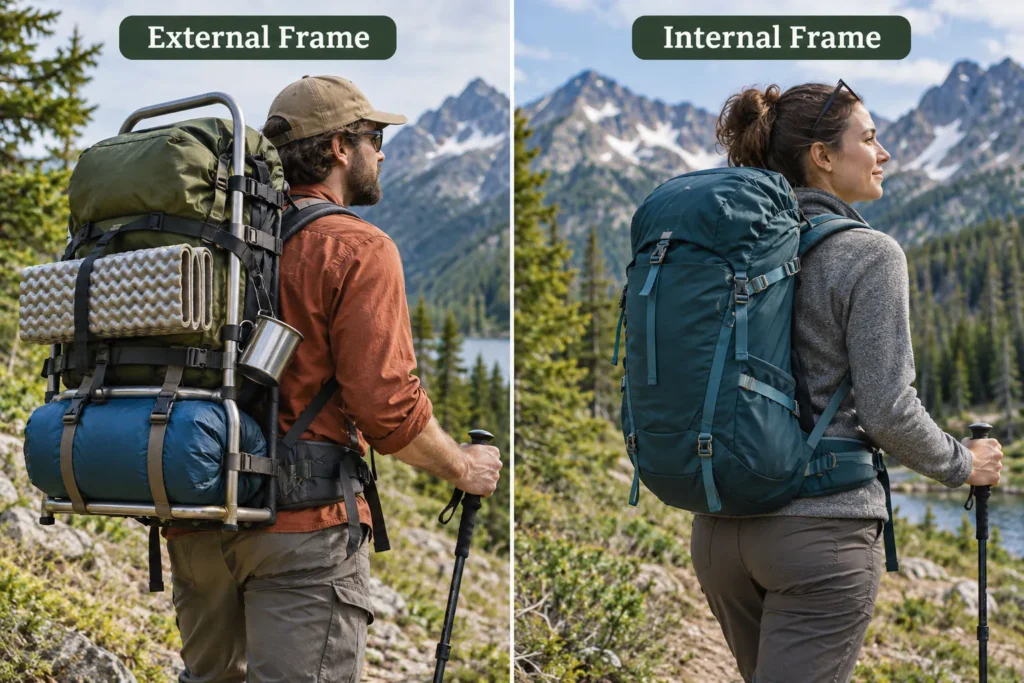
External and internal frames represent two different approaches to the same challenge: carrying a substantial load comfortably and securely.
External-frame backpacks hold the load farther from the torso. This can improve ventilation and provide convenient external attachment points, making them useful for certain trail and load-carrying applications.
Internal-frame backpacks keep the load closer to the body. This improves stability when the wearer moves across uneven terrain, climbs, scrambles, or changes direction frequently.
A major turning point came in 1967, when Greg Lowe developed an early internal-frame backpack designed to combine load support with greater flexibility and body movement.
The concept proved especially suitable for technical outdoor use.
Over time, internal frames became dominant in hiking and travel backpacks, while external frames became more specialized.
Neither approach is inherently “the best.”
They reflect a recurring theme in backpack history: every design is a trade-off between load transfer, stability, ventilation, weight, access, and intended use.
How the Backpack Became Everyday School Gear

The modern school backpack did not begin as a school product.
It came largely from outdoor equipment.
Before backpacks became common among students, books were often carried by hand or secured using simple book straps.
Then lightweight outdoor daypacks began appearing on campuses.
JanSport released its Ski and Hike daypack in 1969. According to reporting on the history of school backpacks, students at the University of Washington began using outdoor packs to carry books.
The reason was practical.
Books were heavy. Students needed both hands free. A durable nylon bag with shoulder straps and zippered compartments solved the problem better than carrying a stack of textbooks.
Other companies recognized the same opportunity.
Backpacks designed specifically around books and student needs began appearing through the 1970s and 1980s. L.L.Bean’s Book Pack and later student-oriented JanSport designs helped move the backpack firmly from outdoor equipment into everyday school life.
By the late 1980s, backpacks had become a standard part of student life.
Then the contents changed again.
Books were joined by calculators, portable electronics, tablets, and laptops.
The backpack changed with them.
Padded laptop compartments, cable organization, reinforced bottoms, water-bottle pockets, and smaller tech-accessory compartments became increasingly common.
The product survived because the design kept responding to what people carried.
How Backpack Design Influences Modern Manufacturing
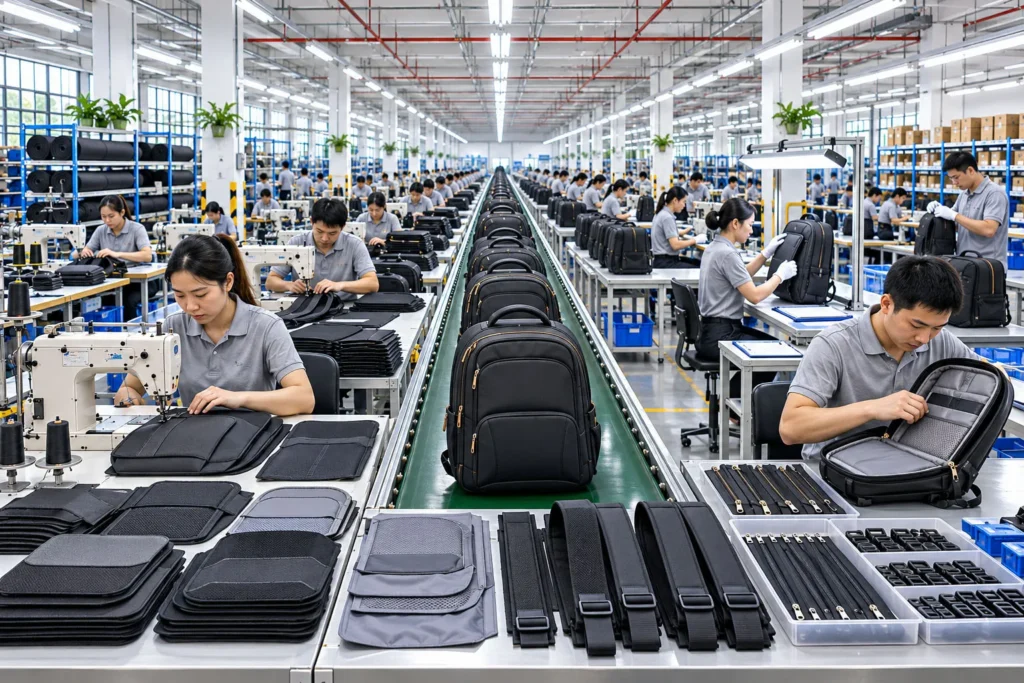
The backpack may have evolved over thousands of years, but its history still influences the way backpacks are manufactured today.
Every major design improvement creates a manufacturing requirement.
A padded shoulder strap, for example, is not simply a strap. It may require outer fabric, foam, mesh, webbing, binding, reinforcement stitching, and hardware to work together correctly.
A ventilated back panel may combine spacer mesh, foam, shaped padding, reinforcement sheets, and structural stitching.
A laptop compartment needs adequate padding, lining, dimensions, opening clearance, and positioning inside the main bag.
Even something as simple as adding another zipper can change the pattern, cutting plan, sewing sequence, material consumption, labor time, and final cost.
That is why modern backpack production usually begins well before sewing.
For brands developing a new product, the process generally moves through design specifications, material selection, pattern development, sampling, revisions, cutting, sewing, assembly, quality inspection, and packing.
You can see the complete production sequence in How Are Backpacks Manufactured? A Complete Backpack Manufacturing Process Guide.
Material choices are equally important.
A lightweight commuter backpack, structured laptop backpack, waterproof outdoor pack, school backpack, and tactical backpack may all use very different combinations of outer fabric, lining, foam, reinforcement, webbing, zippers, buckles, and stitching.
For brands developing their own designs, working with an experienced custom backpack manufacturer helps translate features on a drawing into a structure that can actually be sampled and produced consistently.
The goal of manufacturing is not simply to reproduce the shape of a backpack.
It is to make sure that its materials, construction, ergonomics, hardware, reinforcement, workmanship, and cost all support the way the product is intended to be used.
From Historical Innovation to Modern Backpack Production
Modern backpacks look very different from ancient wooden carrying frames, but the design process still follows the same logic.
A user has a problem.
The backpack changes to solve it.
Heavy loads led to frames and hipbelts.
Difficult access led to zippered compartments.
Sweaty backs led to ventilation systems.
Different body sizes led to adjustable harnesses.
Computers led to padded laptop compartments.
Modern brands continue that process by developing backpacks for increasingly specific uses — commuting, travel, outdoor activities, business, school, cycling, tactical use, delivery, photography, and countless niche applications.
At the manufacturing level, those ideas must eventually become patterns, fabric panels, foam pieces, straps, zippers, buckles, stitching lines, and measurable quality standards.
Tamador works with international brands, wholesalers, distributors, and other B2B buyers as a backpack manufacturer providing OEM and ODM development from design and sampling through bulk production and quality control.
In that sense, modern backpack manufacturing is simply the newest stage in the same long history: identify what the user needs, design a better solution, and find a reliable way to produce it.
Common Misconceptions About Backpack History
Backpack history becomes confusing when ancient carrying practices, patents, and commercial products are treated as the same thing.
Here are some of the most common misconceptions.
“One person invented the backpack.”
No.
People have carried loads on their backs for thousands of years. What individual inventors developed were particular solutions — frames, braces, hipbelts, zippers, internal supports, ventilation systems, and other features.
The backpack itself evolved gradually.
“The first backpack patent created the modern backpack.”
Not exactly.
Henry Merriam’s 1878 knapsack was an important documented design, but a patent proves that an idea was formally recorded. It does not mean the design became commercially successful or established the modern backpack category.
“External frames are obsolete.”
Not completely.
Internal frames became dominant because they offer excellent stability and close-to-body load control, particularly on technical terrain.
External frames still provide advantages for specific load-carrying applications, including ventilation and external gear attachment.
They are better described as specialized rather than extinct.
“School backpacks evolved directly from book straps.”
Not really.
Modern school backpacks largely grew out of outdoor daypacks.
Students discovered that lightweight packs designed for hiking also happened to solve an everyday problem: carrying heavy books comfortably while keeping both hands free.
“Every hipbelt transfers weight to the hips.”
No.
A waist strap can simply stabilize a bag around the body.
Effective load transfer depends on backpack structure, fit, frame design, belt construction, and how the entire carrying system interacts with the wearer.
FAQ
Who invented the backpack?
No single person invented the backpack.
Back-carrying systems existed thousands of years before modern patents. Later inventors developed particular features and structures, including Henry Merriam’s 1878 military knapsack, Ole Bergan’s framed rucksack, Kelty’s improvements to load-carrying systems, and Greg Lowe’s internal-frame design.
The modern backpack is the result of many innovations rather than one invention.
Who made the first backpack?
There is no confirmed single maker of the first backpack.
Ancient people used bags, wooden frames, hides, straps, and other carrying systems long before written records or patents existed.
If the question refers to early patented modern backpack designs, Henry C. Merriam’s 1878 knapsack is one important documented example.
When was the first backpack patented?
Henry C. Merriam’s U.S. knapsack patent was granted in 1878.
Later patents and commercial designs continued to refine external frames, carrying systems, materials, closures, and ergonomics.
What did the internal frame solve?
Internal frames improved stability by keeping the backpack closer to the wearer’s body.
This is especially useful on uneven or technical terrain where a tall external-frame load may move more noticeably as the wearer changes position.
Why do backpack hipbelts matter?
A properly designed load-bearing hipbelt can transfer a significant portion of backpack weight away from the shoulders and toward the pelvis.
That can improve comfort when carrying heavier loads over longer periods.
When did students start using backpacks?
Outdoor-style backpacks began appearing among students in significant numbers during the late 1960s and 1970s.
By the 1980s, purpose-designed school backpacks had become widely established, and by the late 1980s the backpack was a normal part of student life.
How are modern backpacks made?
Modern backpacks are typically produced through design development, material sourcing, pattern making, sampling, fabric cutting, sewing, component assembly, quality inspection, finishing, and packing.
For a detailed explanation, see How Are Backpacks Manufactured?.
What materials are modern backpacks made from?
Common backpack materials include nylon, polyester, canvas, RPET recycled polyester, PU, mesh, foam, webbing, zippers, buckles, lining fabrics, and structural reinforcement.
The exact combination depends on the intended use of the backpack.
For a full material breakdown, read What Is a Backpack Made Of?.
Conclusion: A History of Solved Problems
The history of the backpack is really a history of solved problems.
The body complains — the load is heavy, the shoulders hurt, the back is sweating, the gear is difficult to reach — and designers respond.
Ancient carriers created frames.
Military designers experimented with braces and structured load systems.
Outdoor pioneers developed lighter fabrics, better frames, padded straps, hipbelts, ventilation, and easier access.
Students turned hiking daypacks into everyday book bags.
Modern users brought laptops, electronics, hydration systems, security features, recycled materials, and entirely new product categories.
So who invented the backpack?
No single person did.
The backpack was built gradually by generations of people trying to carry things more comfortably, securely, and efficiently.
That process has never really stopped.
Today’s backpack may use nylon instead of hide, foam instead of simple padding, engineered mesh instead of bare wood, and precision-cut components instead of hand-shaped frames — but the design question remains exactly the same:
What problem does the person carrying this backpack need it to solve?