
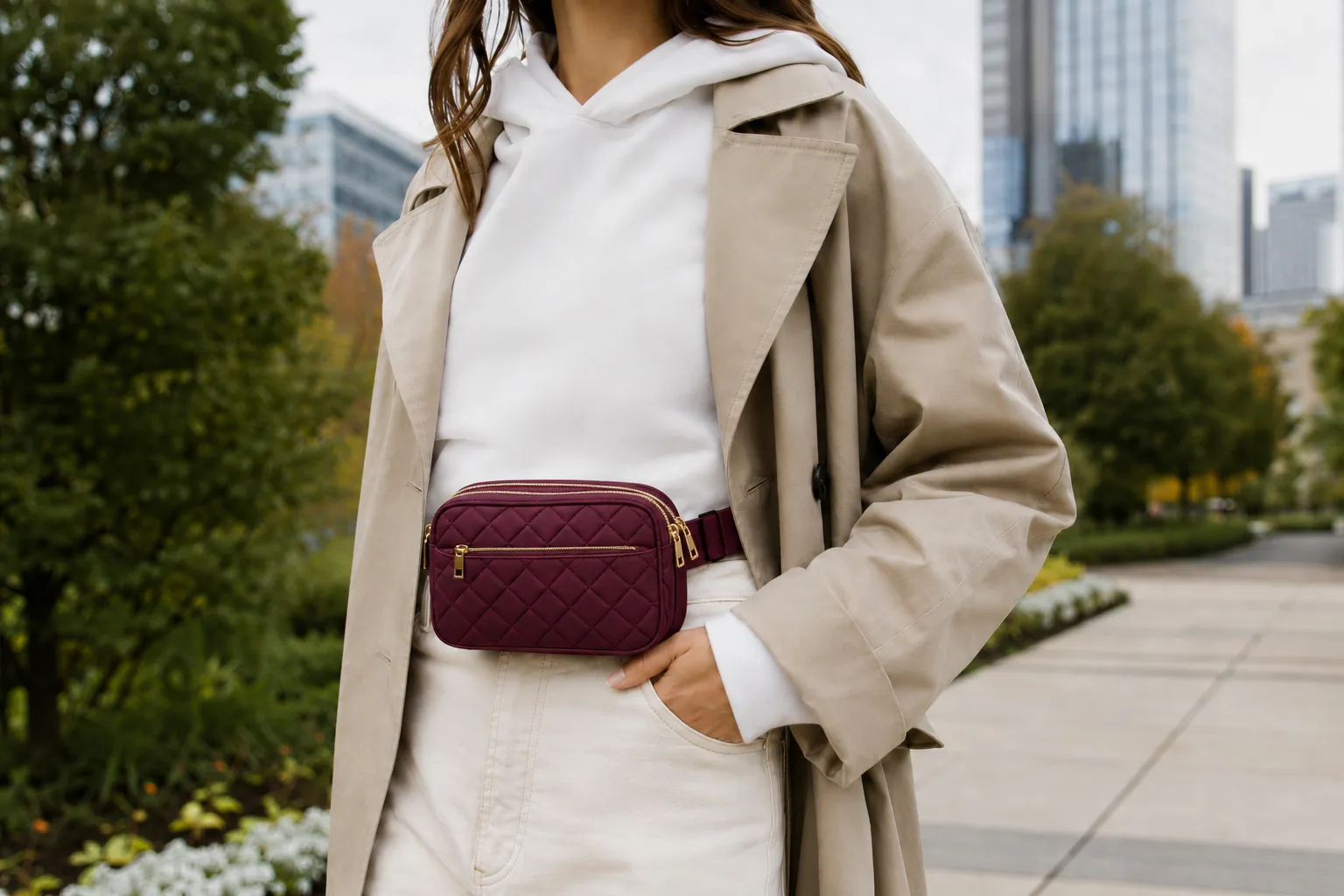
A fanny pack is a small pouch-style bag worn with a strap around your waist or hips, designed to hold your essentials hands-free while keeping them within easy reach.
It is the same item you will hear called a belt bag, waist bag, or bum bag — the name mostly depends on where you live and how you wear it. In the United States, Merriam-Webster defines it simply as a pack that straps to the waist and is used for carrying personal articles such as your phone, wallet, keys, and cards.
Why So Many Names for the Same Bag?
The terminology is genuinely regional. What Americans call a fanny pack, Brits and Australians call a bum bag. The fashion world tends to use belt bag or waist bag, and when you sling the same shape diagonally across your chest, it becomes a crossbody bag.
Wikipedia records even more local variations, from South Africa’s “moon bag” to France’s “banana bag” and Italy’s “marsupio.”
That naming confusion tells you something useful: the fanny pack has never really gone away. It has simply kept changing its name, styling, and the way people wear it.
A History Much Older Than You Think
The waist-worn pouch is one of the oldest carrying inventions in human history.
In a history of the fanny pack, VICE points out that one of the earliest known examples belongs to Ötzi the Iceman, whose 5,000-year-old remains were discovered with a belt and attached pouch.
Medieval Europeans also carried leather belted purses for essentially the same reason people use fanny packs today: hands-free access to small essentials.
The modern version took shape much more recently. Mental Floss traces it back to a 1954 Sports Illustrated advertisement for a leather pouch marketed to cross-country skiers who wanted to carry wax and lunch.
An Australian designer, Melba Stone, is also widely credited with creating the contemporary “bum bag” in 1962.
The bag exploded in popularity during the 1980s and 1990s, drifted out of mainstream fashion in the 2000s, and then returned strongly in the mid-2010s.
Luxury houses, streetwear brands, sportswear labels, and outdoor companies all helped reposition the bag from a tourist cliché into an intentional style choice.
Why the Fanny Pack Is Popular Again
The revival rests on one simple thing: the bag solves a real problem.
It carries your daily essentials without occupying your hands, and it keeps them close enough that you do not need to search through a larger purse or backpack.
That practicality has translated into measurable demand.
Market estimates vary because some reports measure only fanny packs while others cover the broader waist- and belt-bag category, but the direction is consistent.
Fact.MR values the global fanny pack market at roughly US$199.65 million in 2024, with projected growth through 2034.
Other market reports place the broader fanny-pack category at more than US$1 billion, with continued growth expected over the coming years.
Trend data also points in the same direction: search interest continues to rise around travel, festivals, outdoor use, commuting, and everyday hands-free carry.
The generational shift matters too.
Gen Z and Millennial consumers increasingly value accessories that are both functional and fashionable. At the same time, retro 1990s-inspired silhouettes have returned, while belt bags and crossbody styles have helped the category feel more contemporary.
How to Wear a Fanny Pack
There is no single correct way to wear one, and that flexibility is part of its appeal.
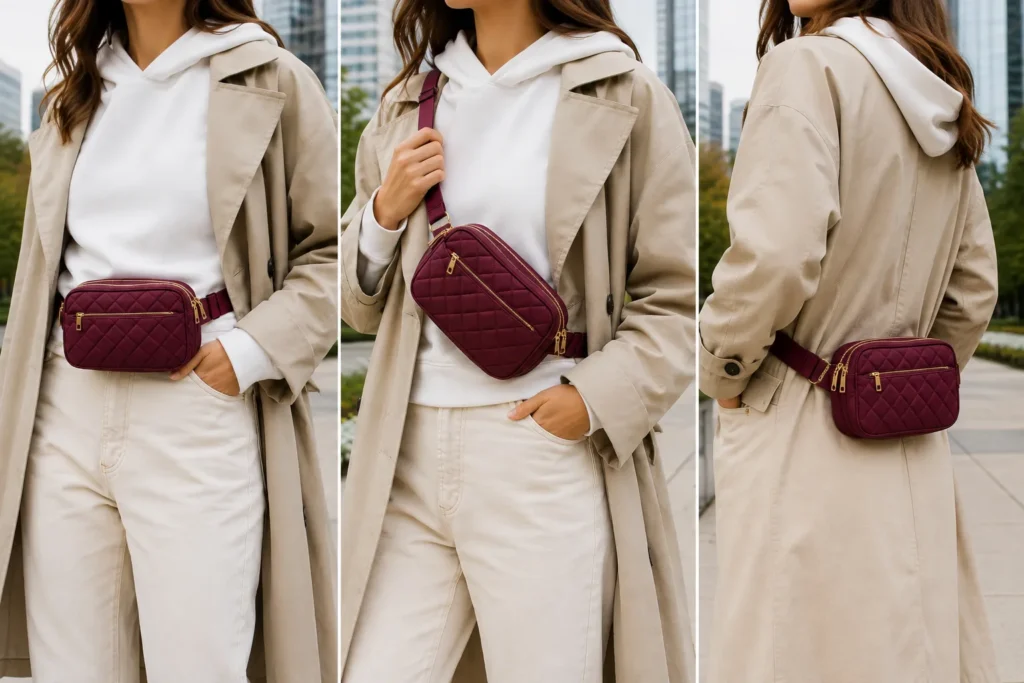
- Around the waist, pouch in front — the classic and often the most secure option. You can see and reach your belongings easily, which makes it a strong choice for travel and crowded spaces.
- Crossbody across the chest — a more modern style that works especially well for commuting, city use, and keeping valuables close.
- At the hip or on the back — comfortable for larger packs and outdoor activities, although you lose some of the quick front access.
The right position ultimately depends on the pack’s size, weight, activity, and your personal preference.
Choosing the Right Material
The material is one of the biggest factors in how a fanny pack looks, feels, and performs.
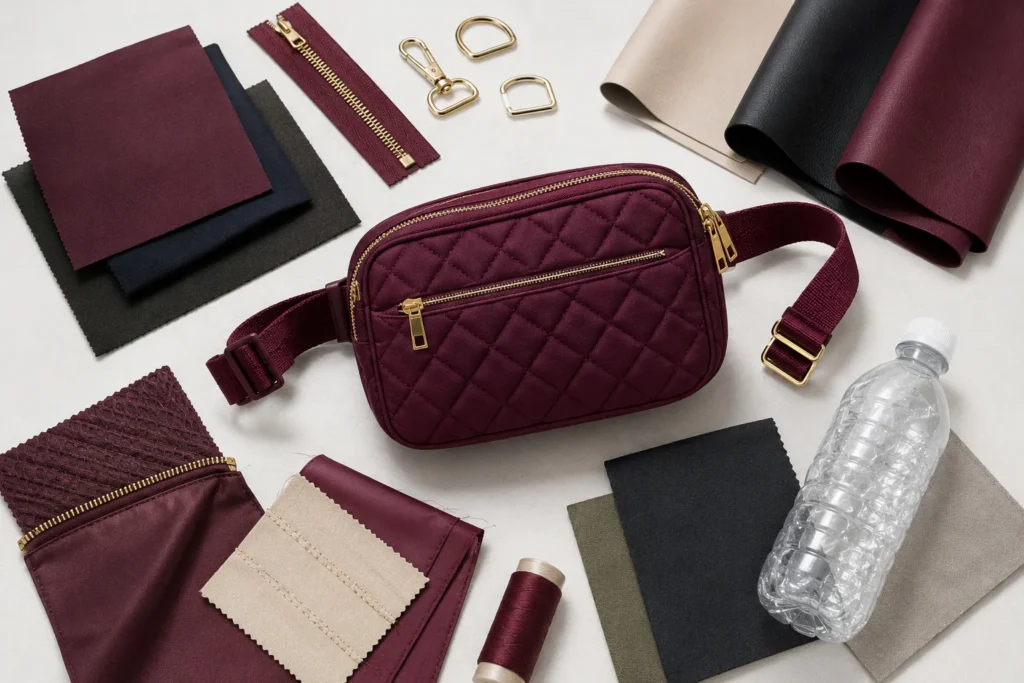
- Nylon — lightweight, durable, easy to clean, and often water-resistant. It is commonly used for travel, commuting, sports, and outdoor bags.
- Polyester — versatile, cost-effective, durable, and available in a wide variety of finishes and weights.
- Leather or vegan leather — polished and elevated, making it popular for fashion-oriented designs and premium collections.
- RPET recycled polyester — made from recycled plastic bottles and increasingly used in eco-conscious bags, branded merchandise, and private-label collections.
Many modern fanny packs combine materials, such as a nylon or recycled polyester shell with PU leather trims, reinforced webbing, metal hardware, and technical linings.
For brands developing their own collection, material selection is usually finalized during sampling with an experienced fanny pack manufacturer, because fabric weight, coating, hardware, lining, and reinforcement all affect durability, appearance, production cost, and final performance.
Who Actually Uses a Fanny Pack?
The audience is much broader than many people expect.
Commuters wear belt bags to keep a phone, wallet, earbuds, and transit card accessible during the daily rush.
Travelers appreciate secure, close-to-body storage for passports, currency, and boarding documents.
Festival-goers want something compact that is less likely to get lost in a crowd.
Hikers and runners value lightweight organization and easy access to snacks, keys, or small accessories.
Parents use them for quick access to wipes, phones, cards, and other essentials while keeping both hands free.
Brands also use fanny packs as retail products, promotional merchandise, outdoor accessories, sports products, and private-label fashion items.
For outdoor-oriented products, features such as water-resistant fabrics, reinforced straps, secure buckles, MOLLE webbing, and additional compartments can also be developed through specialized options such as waterproof fanny pack manufacturing or MOLLE fanny pack manufacturing.
How Is a Fanny Pack Made?
Although a fanny pack may look simple, producing one consistently at scale requires several manufacturing steps.
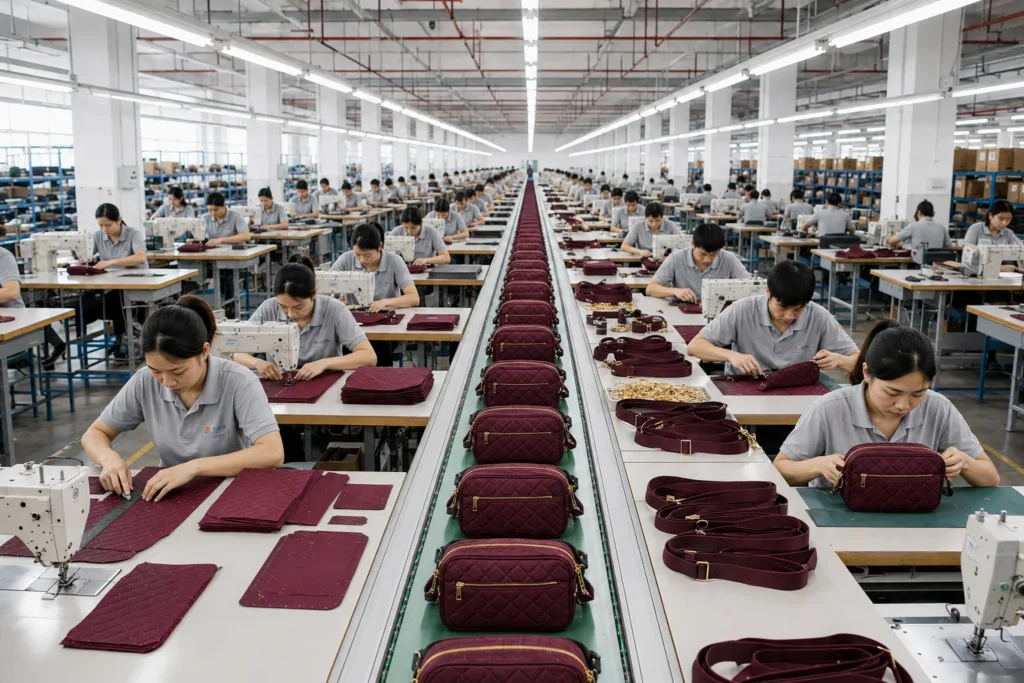
The process usually begins with material selection and pattern development. The manufacturer chooses the outer fabric, lining, webbing, zippers, buckles, foam, hardware, and reinforcement based on the product’s intended use.
Patterns are then created for the main body, pockets, gussets, lining, and strap components.
After the materials are approved, production typically moves through several stages:
- Fabric inspection
- Pattern cutting
- Logo printing, embroidery, or label application
- Pocket and zipper construction
- Main body sewing
- Strap and buckle assembly
- Lining installation
- Trimming and shaping
- Final inspection and quality control
- Packing and shipment preparation
For a custom project, the process usually starts with a prototype or pre-production sample before bulk manufacturing begins.
This allows the brand and manufacturer to check dimensions, pocket structure, strap length, zipper quality, logo placement, comfort, and overall appearance before full production.
Brands planning their own collection can usually achieve better results by working with a custom fanny pack manufacturer early in the development process rather than waiting until the design is completely finalized.
For more demanding applications, the structure can also be adapted for specific use cases such as tactical fanny packs or travel fanny packs.
What Makes a Good Fanny Pack?
A good fanny pack is not just about appearance.
The most practical designs usually balance several factors:
Comfort.
The strap should be adjustable and wide enough to distribute weight comfortably.
Easy access.
Main compartments should open naturally without forcing the user to remove the bag.
Secure storage.
Zippers, buckles, and pocket placement should help keep valuables protected.
Durability.
Stress areas around the strap, buckle, zipper ends, and seams should be reinforced.
Appropriate size.
The bag should carry the intended essentials without becoming unnecessarily bulky.
Material suitability.
A lightweight nylon bag may work well for hiking or travel, while a structured PU or leather style may be better suited to fashion retail.
For commercial products, manufacturing consistency is equally important. A successful design needs to look and perform the same way across hundreds or thousands of pieces.
Brands that need custom dimensions, logo applications, pocket layouts, hardware, packaging, or material combinations can develop these details through custom fanny pack manufacturing.
Frequently Asked Questions
Are fanny packs still in style in 2026?
Yes. The shift toward everyday utility, hands-free carry, travel convenience, and crossbody styling has helped make the fanny pack a mainstream accessory again rather than simply a retro trend.
Is a fanny pack the same as a belt bag?
For the most part, yes. “Fanny pack” is the traditional American term, while “belt bag” is often used as a more fashion-oriented retail term for the same type of waist-worn pouch.
What is a fanny pack used for?
A fanny pack is used to carry small essentials such as a phone, wallet, keys, cards, sunscreen, passport, or snacks while keeping your hands free. It is commonly used for travel, commuting, festivals, hiking, running, and everyday errands.
How do you wear a fanny pack for security?
Wear it around your waist with the pouch in front, or crossbody with the pouch positioned on your chest. Keeping the bag where you can see and reach it is generally the safest arrangement in crowded areas.
What material is best for a fanny pack?
It depends on the intended use. Nylon and polyester work well for travel and outdoor products, while PU, vegan leather, or genuine leather are more suitable for fashion-oriented designs.
Can fanny packs be customized for a brand?
Yes. Fanny packs can be customized with different fabrics, colors, dimensions, pockets, zippers, buckles, logo methods, labels, packaging, and other private-label features. Brands can work directly with a custom fanny pack manufacturer to develop these specifications before bulk production.
Next Steps for Bag Brands and Retailers
If you are here because you design, source, or sell bags at scale, the continued popularity of the fanny pack represents more than a fashion trend — it is also a product development opportunity.
Bringing a waist bag, belt bag, or crossbody-style fanny pack collection to market requires a manufacturing partner that can manage materials, pattern development, sampling, hardware, logo application, quality control, and reliable bulk production.
Tamador is an OEM and ODM bag manufacturer in Guangzhou, China, supporting international brands, wholesalers, importers, distributors, and corporate buyers from product development through mass production.
For brands planning a custom fanny pack collection, working with an experienced fanny pack manufacturer can help turn an initial concept into a production-ready product while improving material selection, construction, durability, cost control, and manufacturing consistency.
If your project requires custom dimensions, fabrics, logos, pockets, hardware, labeling, or packaging, you can also explore Tamador’s custom fanny pack manufacturing capabilities for sampling, private labeling, material sourcing, and bulk production.