
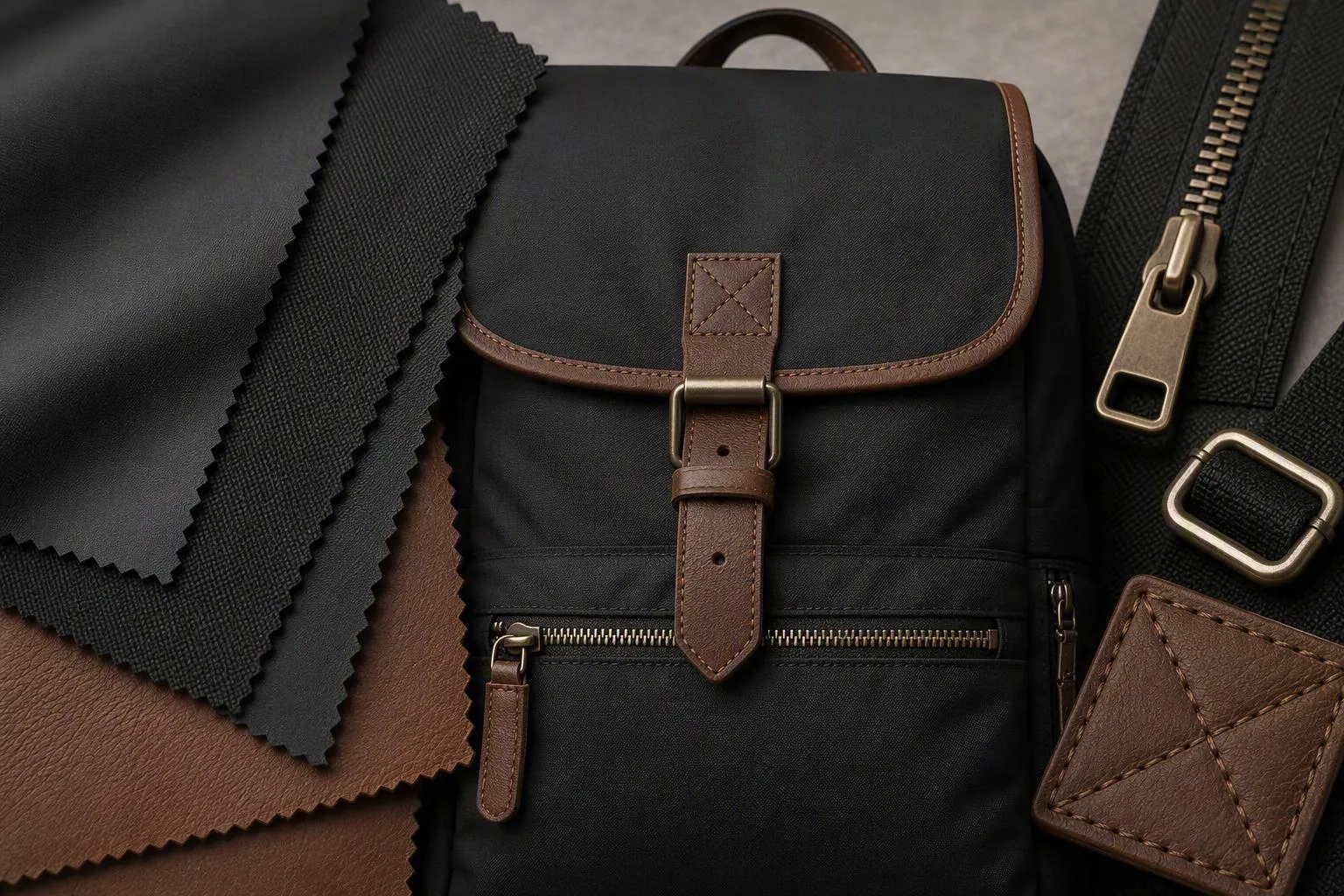
A backpack is made of more than a single piece of fabric. It is a layered product made from an outer shell, lining, foam, mesh, webbing, zippers, buckles, reinforcement materials, and stitching — with each component selected for a specific purpose.
For most backpacks, the outer shell is made from nylon, polyester, canvas, or recycled polyester (RPET). Behind the shell are the lining, padding, zippers, hardware, and structural components that determine how comfortable, durable, and functional the backpack will be.
Understanding what a backpack is made of matters because material choices affect weight, water resistance, abrasion resistance, appearance, cost, and lifespan. For brands developing a new product, material selection is also one of the first major decisions to confirm with a professional backpack manufacturer.
The Most Common Backpack Materials
Here is a quick comparison of the materials most commonly used in backpack manufacturing.
| Material | Durability | Weight | Water Resistance | Best For |
|---|---|---|---|---|
| Nylon | High | Light–medium | Good when coated | Travel, commuting, outdoor |
| Polyester | Medium–high | Light | Moderate when coated | School, promotional, everyday |
| Canvas | High | Heavy | Low unless treated | Lifestyle, rugged, heritage |
| Leather | Very high | Heavy | Moderate when treated | Premium and fashion applications |
| RPET (Recycled Polyester) | Medium–high | Light–medium | Similar to polyester | Eco-conscious brands |
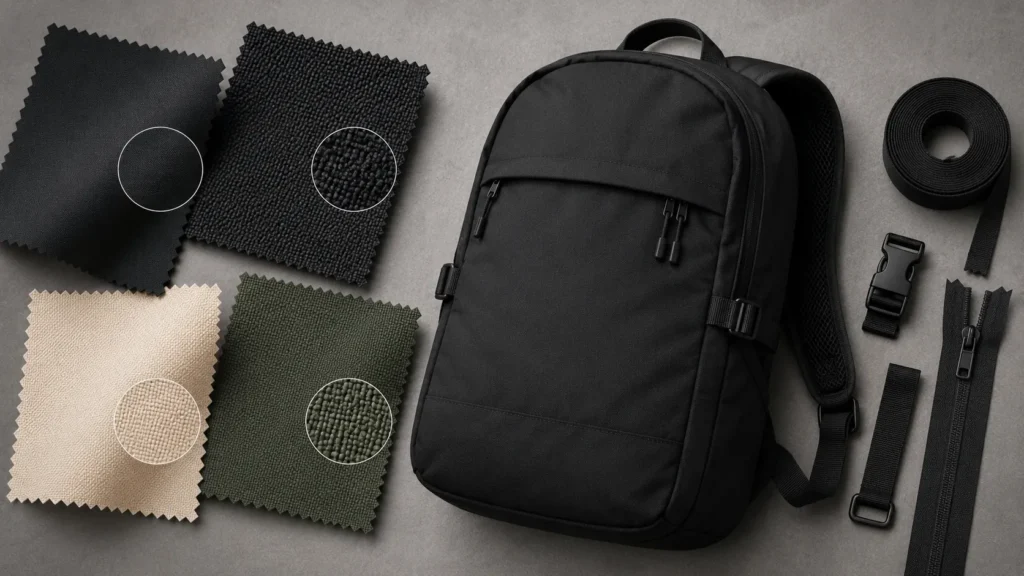
Nylon
Nylon is one of the most widely used backpack materials because it provides a strong balance of durability, low weight, and abrasion resistance.
It is commonly used in travel, commuting, outdoor, and premium backpacks. Higher-denier versions and specialty constructions such as ripstop, Cordura, and ballistic nylon provide even greater resistance to wear and tearing.
Polyester
Polyester is lightweight, cost-effective, and widely available. It is especially common in school backpacks, promotional bags, and everyday products.
It also holds color well and can be produced in a wide range of finishes and textures. Compared with similar-weight nylon, polyester is generally less abrasion-resistant, but it is often a better choice for price-sensitive projects.
Canvas
Canvas provides a heavier, more structured feel and is often selected for lifestyle, heritage, and casual backpack designs.
Its main trade-offs are weight and water absorption. Untreated canvas can absorb moisture, so waxed or coated versions are often used when additional weather resistance is required.
Leather
Leather may be used in full-leather premium backpacks or as a trim material on fabric backpacks.
It offers a premium appearance and good longevity when maintained properly, but it is heavier and typically requires more care than synthetic fabrics. For many commercial backpack projects, leather is used selectively for trims, handles, or decorative panels rather than the entire bag.
RPET Recycled Polyester
RPET is recycled polyester commonly produced from post-consumer plastic materials.
Its performance can be similar to conventional polyester, making it a popular option for brands that want to add recycled content without significantly changing the product’s structure or functionality.
What Backpack Fabric Specifications Actually Mean
When choosing backpack fabric, the material name alone does not tell the whole story. Fabric weight, yarn thickness, weave, coating, and finish all influence performance.
Denier
Denier, usually shown as D, refers to yarn thickness.
For example, 600D and 1000D fabrics are commonly used in bags because they provide more structure and durability than very lightweight fabrics. However, a higher denier does not automatically mean better quality. The weave, coating, yarn quality, and finishing process also matter.
Ripstop
Ripstop fabric uses reinforced threads woven into a visible grid pattern.
This structure helps prevent small tears from spreading and is therefore commonly used in outdoor, travel, and technical backpacks.
Coatings and Water Resistance
Backpack fabrics may be treated with:
- PU coating
- TPU coating
- PVC coating
- DWR finish
- Laminated waterproof membranes
These treatments improve water resistance, but a truly waterproof backpack depends on more than fabric alone.
Zipper construction, seam finishing, stitching, and panel design also matter. A waterproof backpack manufacturer should evaluate the entire construction rather than relying only on a waterproof fabric claim.
Backpack Components Breakdown
A backpack is made from several material systems working together.
| Backpack Component | Typical Materials |
|---|---|
| Outer shell | Nylon, polyester, canvas, RPET |
| Lining | Polyester, nylon |
| Padding | EVA foam, PU foam |
| Back panel | Foam, spacer mesh, support sheet |
| Shoulder straps | Shell fabric, foam, mesh, webbing |
| Zippers | Nylon coil, molded plastic, metal |
| Buckles | POM / acetal plastic, metal |
| Webbing | Nylon, polyester, polypropylene |
| Reinforcement | PP board, PE sheet, foam, extra fabric |
| Stitching thread | Polyester or nylon thread |
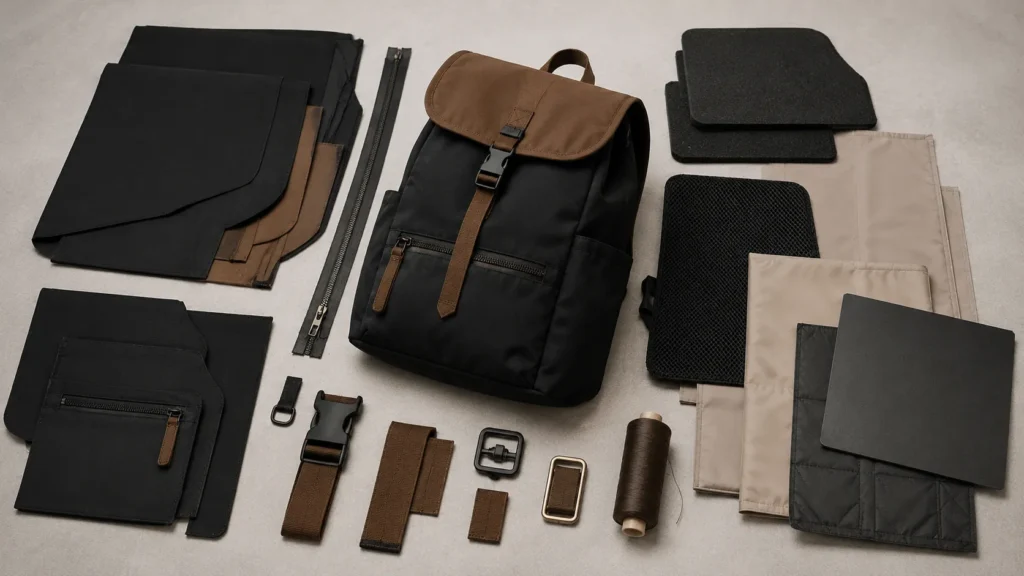
This combination is important because even a strong outer fabric cannot compensate for weak stitching, poor-quality zippers, or insufficient reinforcement.
It’s Not Just the Shell: Lining, Foam, Zippers, and Hardware
Lining
The lining is the inner fabric layer of the backpack.
Polyester and nylon are common choices because they are lightweight, durable, and easy to clean. Some laptop sleeves or delicate-item pockets may also use soft brushed fabric or microfleece to reduce scratching.
Foam and Padding
Foam is used to provide structure, impact protection, and comfort.
Common options include:
- EVA foam
- PU foam
- PE foam
- Laminated padding systems
Foam is typically found in shoulder straps, back panels, laptop compartments, and sometimes the bottom of the backpack.
Mesh
Mesh is commonly used on shoulder straps and back panels to improve ventilation.
Spacer mesh and air mesh are popular because they provide cushioning while allowing airflow between the backpack and the user’s body.
Zippers
Zippers are one of the most frequently used components on a backpack and one of the areas most likely to fail if quality is poor.
Common backpack zipper types include:
- Nylon coil zippers
- Molded plastic zippers
- Metal zippers
- Water-resistant coated zippers
The correct zipper depends on the intended appearance, load, weather resistance, and price point.
Buckles and Hardware
Backpack hardware includes:
- Buckles
- Adjusters
- D-rings
- Hooks
- Sliders
- Rivets
- Clips
Plastic hardware is widely used because it is lightweight and cost-effective. Metal hardware is more common in premium, fashion, or heavy-duty applications.
Webbing
Webbing is used in shoulder straps, adjustment systems, compression straps, carry handles, and attachment points.
Common materials include nylon, polyester, and polypropylene. The appropriate webbing depends on load requirements, feel, price, and intended use.
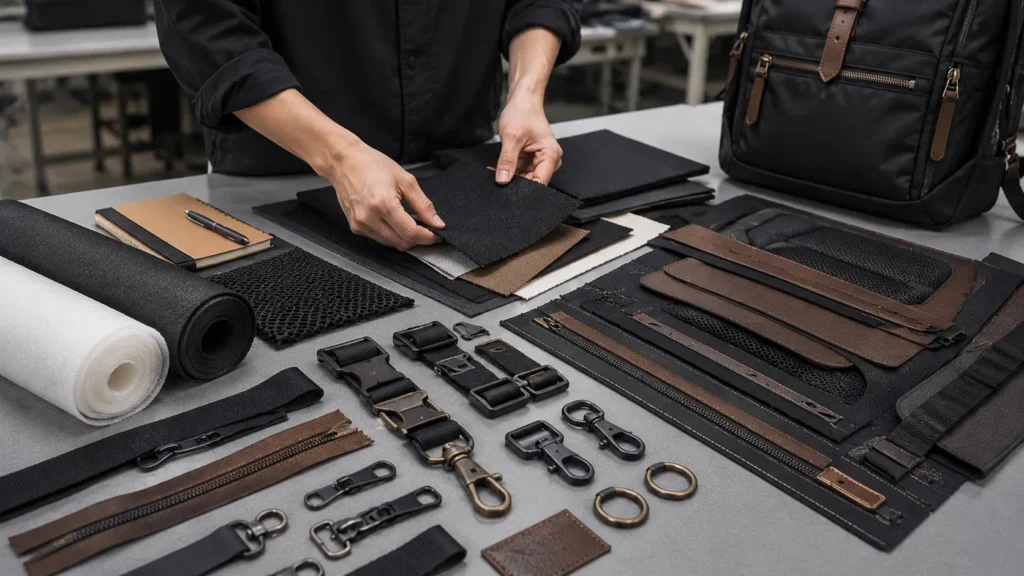
Stitching
Stitching is just as important as the fabric itself.
High-stress areas should normally be reinforced with methods such as:
- Bartack stitching
- Box-X stitching
- Double stitching
- Binding
- Additional reinforcement layers
Typical stress points include shoulder strap anchors, carry handles, bottom corners, and zipper ends.
Choosing the Right Material for How You Will Use the Backpack
The best backpack material depends on the intended application.
Commuting and Everyday Use
Nylon and polyester are usually the most practical choices.
They are lightweight, durable, easy to clean, and available at a wide range of price points.
School Backpacks
Polyester is especially common because it offers good durability, strong color options, and attractive pricing for larger production quantities.
Travel Backpacks
Travel backpacks often benefit from higher-denier nylon, polyester, Cordura-style materials, or coated fabrics because they are exposed to more abrasion and heavier loads.
A professional travel backpack manufacturer should also consider zipper strength, reinforcement, back-panel support, and shoulder-strap construction.
Business and Laptop Backpacks
Business backpacks often use refined polyester, nylon, PU-coated fabrics, or mixed materials with structured foam and clean surface finishes.
Laptop compartments also need sufficient padding and reinforcement. For this category, an experienced business backpack manufacturer can help balance appearance, protection, and weight.
Outdoor Backpacks
Outdoor backpacks commonly use durable nylon, ripstop, coated fabrics, and reinforced webbing.
Material decisions should also account for moisture, abrasion, carrying load, and repeated use in demanding environments.
Eco-Conscious Backpacks
RPET and recycled nylon are increasingly used by brands seeking recycled-content options.
However, sustainability claims should be supported by clear sourcing and appropriate certification when required.
How Backpack Materials Affect Cost
Material selection has a direct effect on backpack manufacturing cost.
Several factors influence pricing:
- Fabric type
- Fabric denier
- Coating or lamination
- Custom color requirements
- Zipper brand and specification
- Buckle and hardware quality
- Foam thickness
- Webbing quality
- Recycled or certified materials
- Order quantity
For example, a standard polyester backpack with basic hardware will usually cost less to manufacture than a backpack made with high-denier nylon, premium zippers, custom metal hardware, and waterproof laminated fabric.
For brands, the goal is not simply to choose the strongest material available. The better approach is to match the material package to the product’s target market, retail price, expected use, and durability requirements.
A professional custom backpack manufacturer can help balance these factors during product development.
What Are Backpack Straps Made Of?
Backpack straps are usually built from several materials rather than a single component.
A typical shoulder strap may contain:
- Outer nylon or polyester fabric
- EVA or PU foam padding
- Spacer mesh on the underside
- Nylon or polyester webbing
- Reinforcement stitching at attachment points
The exact structure depends on the weight the backpack is expected to carry.
What Is the Inside of a Backpack Made Of?
The inside of a backpack is typically made from polyester or nylon lining, combined with foam, reinforcement panels, mesh pockets, zipper compartments, and sometimes soft protective fabric.
Laptop backpacks may also include:
- EVA or PU foam
- Soft brushed lining
- PE or PP reinforcement sheets
- Padded dividers
These internal materials help protect contents and maintain the shape of the backpack.
Frequently Asked Questions
What is the most common backpack material?
Nylon and polyester are the most common backpack materials. Nylon is often chosen for strength and abrasion resistance, while polyester is widely used for everyday, school, and promotional backpacks because of its cost and versatility.
Is nylon or polyester better for a backpack?
Nylon is generally better for applications that require higher abrasion resistance and durability. Polyester is often more cost-effective and works very well for everyday and school backpacks.
The best choice depends on the backpack’s intended use, budget, and construction.
Are backpacks waterproof?
Most backpacks are water-resistant rather than fully waterproof.
PU, TPU, PVC, DWR, and laminated fabrics can improve water resistance, but waterproof performance also depends on the seams, zippers, and overall structure.
What is the most durable backpack material?
High-denier nylon, including Cordura-style and ballistic nylon constructions, is among the most durable backpack material options.
However, overall backpack durability also depends on stitching, reinforcement, zippers, webbing, and hardware.
What are backpack straps made of?
Backpack straps are usually made from nylon or polyester fabric, foam padding, mesh, and webbing. Heavy-load backpacks may also include additional reinforcement at the strap attachment points.
What is the lining of a backpack made of?
Most backpack linings are made from lightweight polyester or nylon. Laptop compartments and protective pockets may also use soft brushed fabric, mesh, or additional foam.
Final Thoughts
So, what is a backpack made of?
A typical backpack combines an outer shell of nylon, polyester, canvas, or RPET with lining, foam, mesh, zippers, webbing, buckles, reinforcement materials, and strong stitching.
The best material combination depends on how the backpack will be used. A lightweight school backpack, a business laptop backpack, and a rugged outdoor pack may all require very different material specifications.
For brands developing a backpack line, material selection should be confirmed early because fabric, coating, zipper, foam, hardware, and reinforcement choices all affect cost, MOQ, durability, appearance, and production lead time.
An experienced OEM or ODM manufacturing partner can help match these materials to your target market and price point. If you are planning a new backpack project, you can explore Tamador’s backpack manufacturer capabilities or discuss a fully customized project with our custom backpack manufacturer team.