
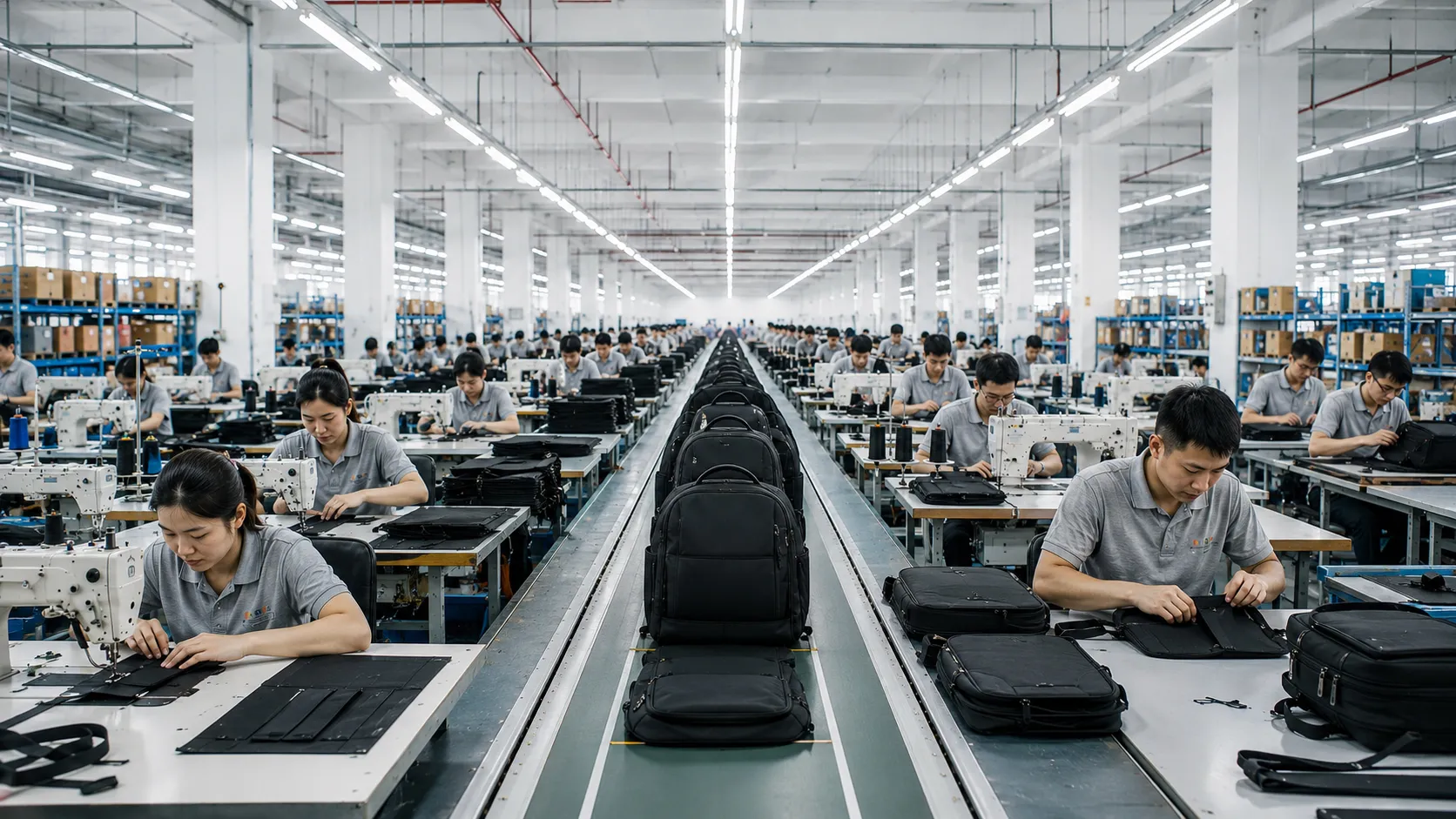
A backpack you see on a store shelf did not begin as a finished product. It started as an idea, moved through design drawings and technical specifications, and then passed through multiple manufacturing stages before becoming a saleable bag. For brand owners, wholesalers, importers, and retailers, understanding this process is important because it affects quality, lead time, cost, and consistency.
In simple terms, backpacks are manufactured through a structured process that usually includes product design, tech pack creation, material sourcing, pattern making, sampling, fabric cutting, sewing and assembly, quality control, and final packing. Each step plays a specific role, and the final result depends on how well every stage is managed.
In this guide, we will walk through the full backpack manufacturing process, explain the key materials and production steps involved, and show what buyers should look for when working with an OEM or ODM factory. If you are planning to develop your own collection, this article will also help you understand how to work more effectively with a professional fabricante de mochilas.
A Quick Overview of the Backpack Manufacturing Process
Before we go into each stage, here is the complete process at a glance.
| Stage | What Happens | Why It Matters |
|---|---|---|
| Concept & Design | Define the bag’s purpose, user, size, features, and price point | Creates the product direction |
| Tech Pack Creation | Convert the concept into technical specifications | Gives the factory clear production instructions |
| Abastecimiento de materiales | Select fabric, lining, foam, zippers, webbing, and hardware | Determines durability, function, and cost |
| Confección de patrones | Turn the design into flat templates for every component | Ensures the backpack can be built accurately |
| Sampling | Produce and refine prototype samples | Confirms construction, fit, and function |
| Fabric Cutting | Cut approved materials into production panels | Affects consistency and material efficiency |
| Costura y montaje | Stitch panels, pockets, straps, and hardware together | Forms the actual backpack structure |
| Control de calidad | Inspect materials, workmanship, and finished products | Reduces defects and improves reliability |
| Finishing & Packing | Clean, shape, label, pack, and prepare for shipment | Protects product quality before delivery |
The short answer to how backpacks are manufactured is that factories move through these stages in sequence, with approval checkpoints between them. Missing one stage or rushing one approval often creates problems later, when they are more expensive and more difficult to fix.
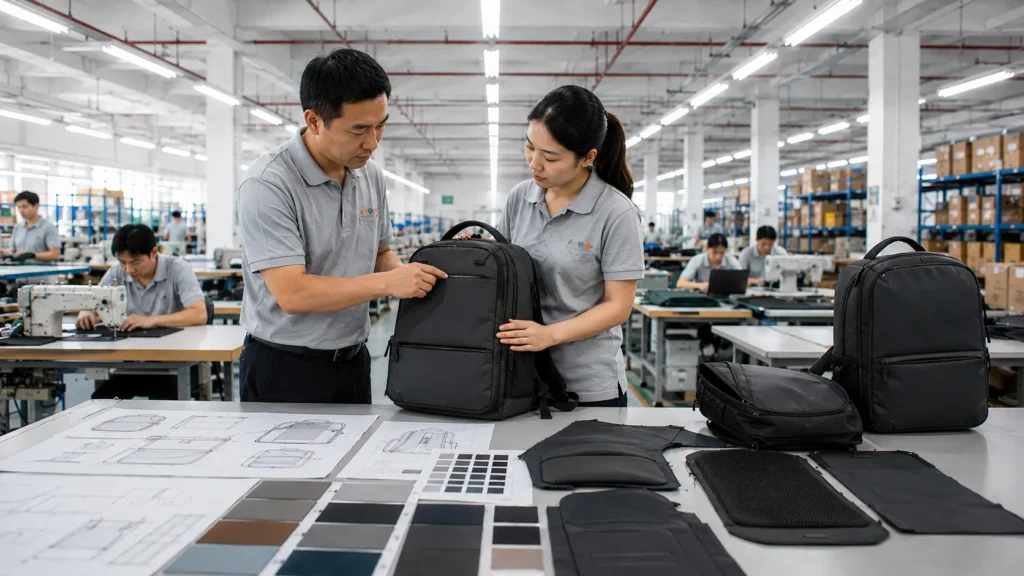
What Happens Before Production Starts: Design and the Tech Pack
Every backpack begins with a concept. A brand first defines what kind of bag it wants to make. Is it a school backpack, business backpack, travel backpack, outdoor pack, or promotional bag? The intended user shapes the structure, capacity, materials, compartments, and price target.
Once the concept is clear, the next step is to build a tech pack. A tech pack is the technical blueprint of the backpack. It usually includes:
- Overall dimensions
- Panel layout
- Pocket structure
- Material specifications
- Lining details
- Foam and reinforcement requirements
- Zipper and hardware placement
- Logo position and branding method
- Stitching instructions
- Packaging notes
A good tech pack reduces mistakes and speeds up communication. In an ODM project, some structural development may already exist and the buyer customizes a factory’s base style. In an OEM project, the buyer usually provides a new design direction and the factory develops the bag based on those requirements. If you are planning a more customized project, working with a professional fabricante de mochilas a medida can make this stage much smoother.
The Materials: What a Backpack Is Actually Made Of
A backpack is not just “fabric plus zipper.” It is a system of materials, and each one affects performance, appearance, and cost.
Shell fabrics
The outer fabric is the main protective layer and the first thing users notice. Common options include:
- Nailon — valued for durability, abrasion resistance, and low weight
- Poliéster — cost-effective and widely used in school, travel, and business bags
- Canvas and duck canvas — heavier materials often used for a more classic look
- Cordura and ballistic nylon — high-performance options for premium and rugged applications
- Ripstop nylon — reinforced with a grid pattern to improve tear resistance
- Recycled polyester (RPET) — an eco-conscious option increasingly used by brands
Fabric denier also matters. Lower denier fabrics are lighter, while higher denier fabrics usually offer better durability. A factory should help match the material choice to the backpack’s positioning and use case.
Coatings and waterproofing
If water resistance is part of the product brief, the outer fabric may receive a coating or laminate. Common treatments include:
- Recubrimiento de PU
- Recubrimiento de PVC
- Recubrimiento de TPU
- Waterproof laminates
Water resistance depends not only on the fabric itself, but also on seam construction, zipper type, and overall design. For projects focused on water protection, insights from a fabricante de mochilas impermeables can be especially useful.
Lining, foam, and mesh
Inside the backpack, you will often find:
- Lining fabric
- Espuma de EVA o de PU
- Spacer mesh or air mesh
- Reinforcement sheets or support panels
These materials influence structure, comfort, and user experience. Shoulder straps, back panels, and laptop compartments often rely on foam and mesh for cushioning and breathability.
Hardware and accessories
Los accesorios de la mochila incluyen:
- Cremalleras
- Sliders and pullers
- Hebillas
- Ajustadores
- Anillas en D
- Remaches
- Correas
- Elastic bands
- Velcro
- Handles and trim
A strong backpack depends on the quality of these components. Even if the main fabric is good, weak hardware can cause early product failure.
Pattern Making and Engineering
After the materials and design direction are confirmed, the factory develops patterns. Pattern making converts the concept into flat templates for each individual component of the backpack, including:
- Front and back panels
- Side panels
- Bottom panels
- Pocket pieces
- Tirantes
- Lining panels
- Reinforcement parts
This stage is both technical and practical. The pattern maker must ensure that the shape is correct, the seam allowances are accurate, the pocket locations work, and the assembled backpack will carry weight properly. Pattern making is the bridge between design and production.
A good pattern is documented, repeatable, and easy for the production team to follow. That is one reason why experienced factories can often move from sample to bulk more efficiently.
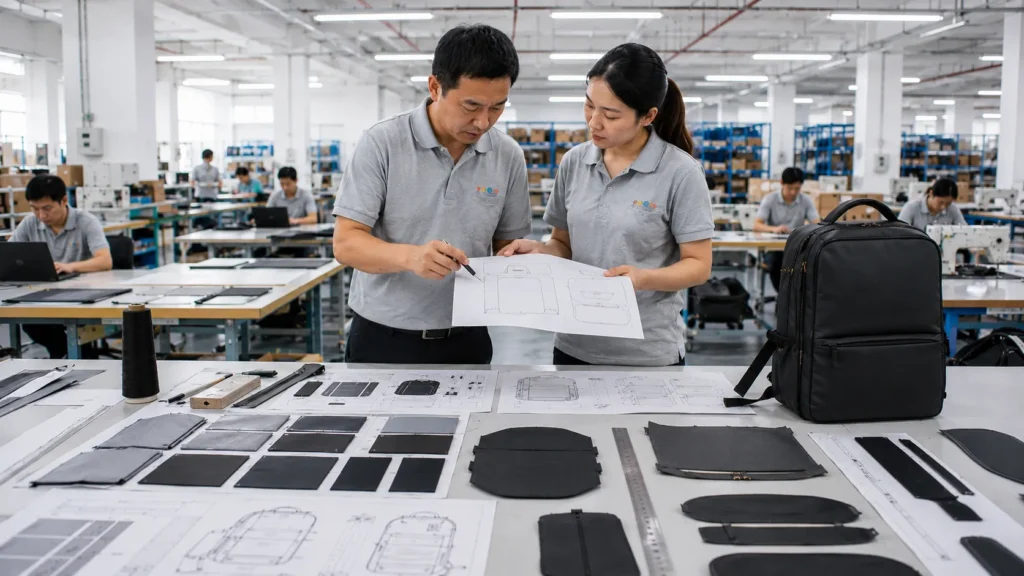
Sampling: Building, Testing, and Refining the Prototype
Before bulk production starts, the factory develops a sample. This is the stage where the backpack becomes a real physical product rather than just a design file.
Most backpack projects go through several rounds of sampling, such as:
- Initial prototype sample — used to translate the concept into a physical bag
- Revised sample — updated based on buyer feedback
- Pre-production sample — final approved version before mass production
During sampling, the buyer and factory review:
- Overall shape and size
- Pocket functionality
- Material appearance
- Comfort and structure
- Stitch quality
- Logo application
- Hardware usability
This is one of the most important stages in the entire manufacturing process. The pre-production sample becomes the reference standard for bulk production. Factories should not move into mass cutting and large-scale assembly until this sample is approved.
Cutting the Fabric
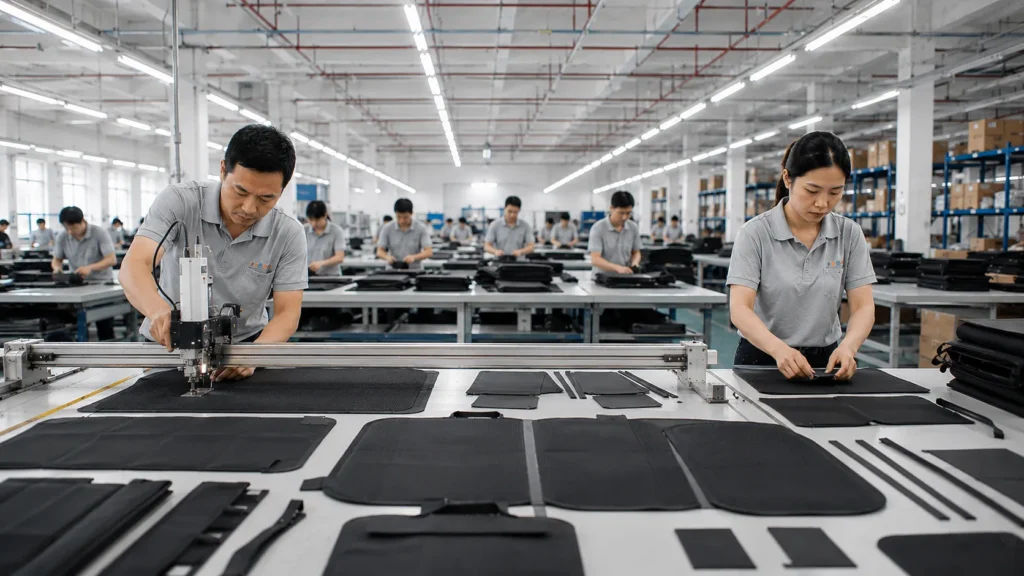
Once the sample is approved and materials are ready, production enters the cutting stage. The factory inspects incoming fabric, lays it on the cutting table, and cuts each panel according to the approved patterns or markers.
Cutting may be done through:
- Manual cutting
- Die cutting
- CNC cutting
- Laser cutting in some specialized cases
Accurate cutting is essential because even small deviations can create problems later in sewing and assembly. Factories also need to control material direction, shade variation, and usage efficiency, especially when working with large production runs.
Sewing and Assembly: Where the Bag Comes Together
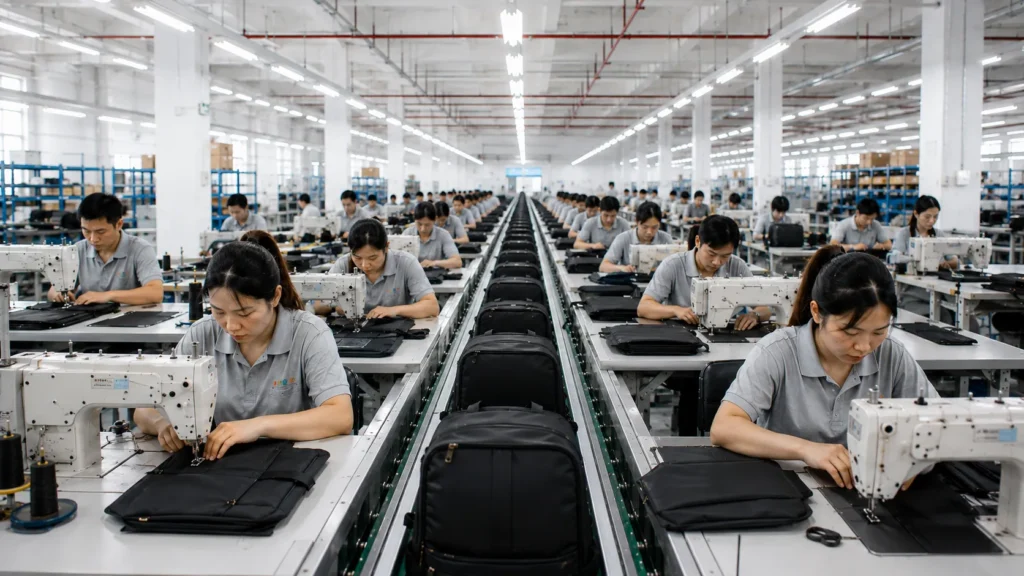
Sewing is the heart of backpack manufacturing. After the fabric panels are cut, operators begin assembling the bag through a sequence of sewing operations.
Usually, smaller components are prepared first, such as:
- Pocket units
- Zipper assemblies
- Asas
- Straps
- Padded back sections
Then the main body is assembled. Workers attach the pockets and zippers, join the front and back panels, add the side panels, sew in the straps and handle system, and close the bag structure. At this stage, reinforcement methods such as bartacks, binding, extra stitching, or rivets may also be applied at stress points.
The most important load-bearing areas on a backpack typically include:
- Shoulder strap attachment points
- Top handle attachment points
- Bottom corners
- Zipper ends
- Back panel connections
These areas require special attention because they are exposed to the highest stress in daily use.
Hardware Testing and Backpack Quality Control Standards
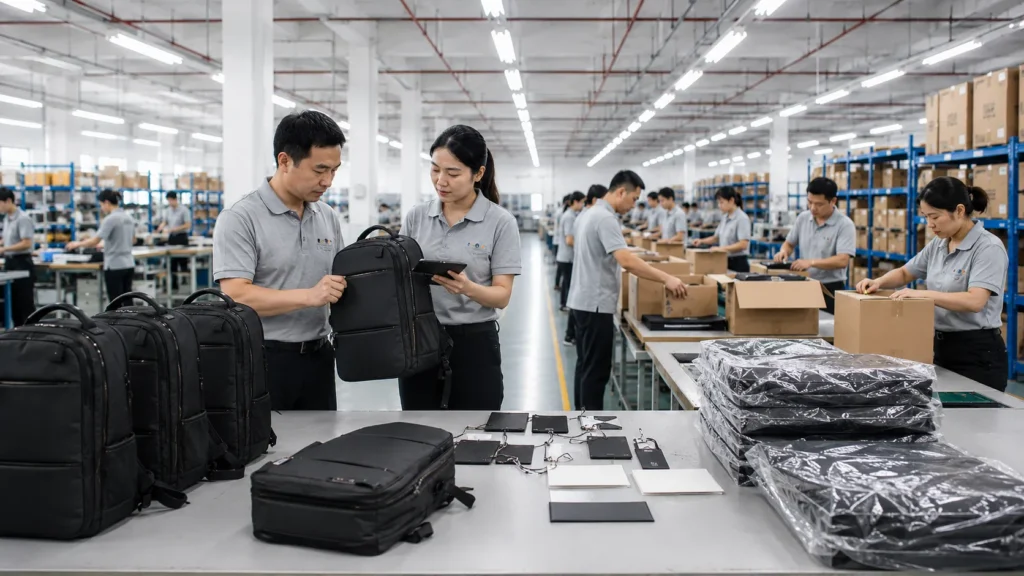
Quality control does not happen only at the end. In a professional factory, quality control is built into the full process. A common three-stage system includes:
- IQC (Incoming Quality Control) — inspection of raw materials and accessories before production
- IPQC (In-Process Quality Control) — inspection during cutting, sewing, and assembly
- OQC / Final Random Inspection — inspection of completed goods before packing and shipment
Sampling standards and AQL
For final inspection, many factories use AQL (Acceptable Quality Limit) standards to define what is acceptable in a shipment. This helps buyers and factories align on inspection criteria before goods are shipped.
Seam strength
Seam strength is critical because seam failure is one of the most common performance issues in backpacks. The required strength level depends on the intended use of the backpack. School backpacks, laptop backpacks, and outdoor packs often have different performance expectations.
Zipper testing
Zippers are among the most frequently used components on a backpack. Factories should check:
- Smoothness of operation
- Strength under tension
- Cycle durability
- Resistance to jamming or misalignment
If you are developing products for commuting or professional use, a reliable fabricante de mochilas de negocios should be able to advise on materials, zipper performance, and load-bearing structure in detail.
Certifications to look for
Depending on your market and product positioning, relevant compliance or certification capabilities may include:
- ISO 9001
- BSCI
- REACH
- OEKO-TEX Standard 100
- GRS
- CPSIA
These are not always mandatory for every backpack project, but they are important signals of quality management, compliance awareness, and market readiness.
Finishing, Packing, and Shipment
After production and inspection, the backpacks move to finishing. This stage may include:
- Cleaning loose threads
- Checking final appearance
- Stuffing the bag to hold its shape
- Hanging tags or labels
- Folding or inserting into polybags or dust bags
- Packing into export cartons
- Carton marking and palletizing
The goal is not only to protect the product, but also to make sure it arrives in good condition and matches the buyer’s packaging requirements.
Lead Times and MOQ: What to Expect
Lead time and MOQ are two of the most common questions buyers ask.
Sample development lead time
For OEM backpack projects, sample development often takes 7–15 days per round, depending on complexity and material availability. Many projects require 2–4 rounds before final approval.
Bulk production lead time
After sample approval, bulk production often takes 25–45 days, although actual timing depends on order quantity, factory scheduling, and material sourcing. More complex projects may take longer.
Cantidad mínima de pedido
MOQ varies by factory, structure, and material combination. In many cases:
- OEM projects may start around 300–500 pieces per style
- Some ODM projects may support lower MOQs
- Highly customized bags may require higher MOQs depending on materials and components
If your project involves larger-capacity or travel-focused styles, consulting an experienced fabricante de mochilas de viaje can help you evaluate realistic MOQ and lead time expectations.
How to Choose an OEM or ODM Backpack Manufacturer
Understanding how backpacks are manufactured also helps you choose the right factory. A dependable manufacturing partner should offer more than just a quotation. You should look for:
- Clear process management from design to shipment
- Strong sample development capability
- Stable material sourcing
- Multi-stage quality control
- Transparent lead time and MOQ communication
- Good communication and confidentiality practices
- Experience in OEM and ODM workflows
A qualified OEM bag manufacturer should be able to explain the process clearly, identify possible issues early, and guide you through material selection, sampling, and production planning.
Common Pitfalls to Avoid
Many backpack sourcing problems are not caused by bad intentions. They usually come from unclear communication or incomplete development work. Common issues include:
1. An unclear tech pack
If the factory receives vague instructions, it has to guess. That usually creates delays, revision rounds, and samples that do not match the intended product.
2. Rushing past the sample stage
Skipping proper sample approval often causes bulk-production mistakes that are much more expensive to fix later.
3. Choosing price over process
The lowest quote does not always create the best total value. Weak process control often leads to inconsistency, defects, and hidden costs.
4. Ignoring material consistency
Shade variation, coating inconsistency, or weak hardware control can cause visible quality differences across a production batch.
Why the Manufacturing Process Matters
A backpack is a small engineered product. Every panel, seam, zipper, and reinforcement point contributes to the final result. When buyers understand the process, they can write better briefs, communicate better with factories, and make better sourcing decisions.
This is also why working with an experienced manufacturing partner matters. A factory with deep backpack production knowledge can help bridge the gap between an idea and a market-ready product, whether you are developing a school bag, laptop bag, travel pack, or a fully customized private-label line. If you are exploring your next project, you can start by reviewing Tamador’s capabilities as a fabricante de mochilas or discussing your concept with a fabricante de mochilas a medida.
Reflexiones finales
So, how are backpacks manufactured? The answer is through a structured process that begins with product design and tech pack development, moves through material sourcing, pattern making, sampling, cutting, sewing, and quality control, and ends with packing and shipment.
For brands, importers, and wholesalers, knowing this process is more than general knowledge. It helps you ask better questions, avoid costly mistakes, and choose the right factory partner.
If you are planning to bring a backpack idea to market, working with an experienced manufacturer early in the process can save time and improve results. Tamador supports OEM and ODM backpack development with structured sampling, material guidance, quality control, and scalable production support. To learn more, visit our fabricante de mochilas page or contact us about your fabricante de mochilas a medida project.