
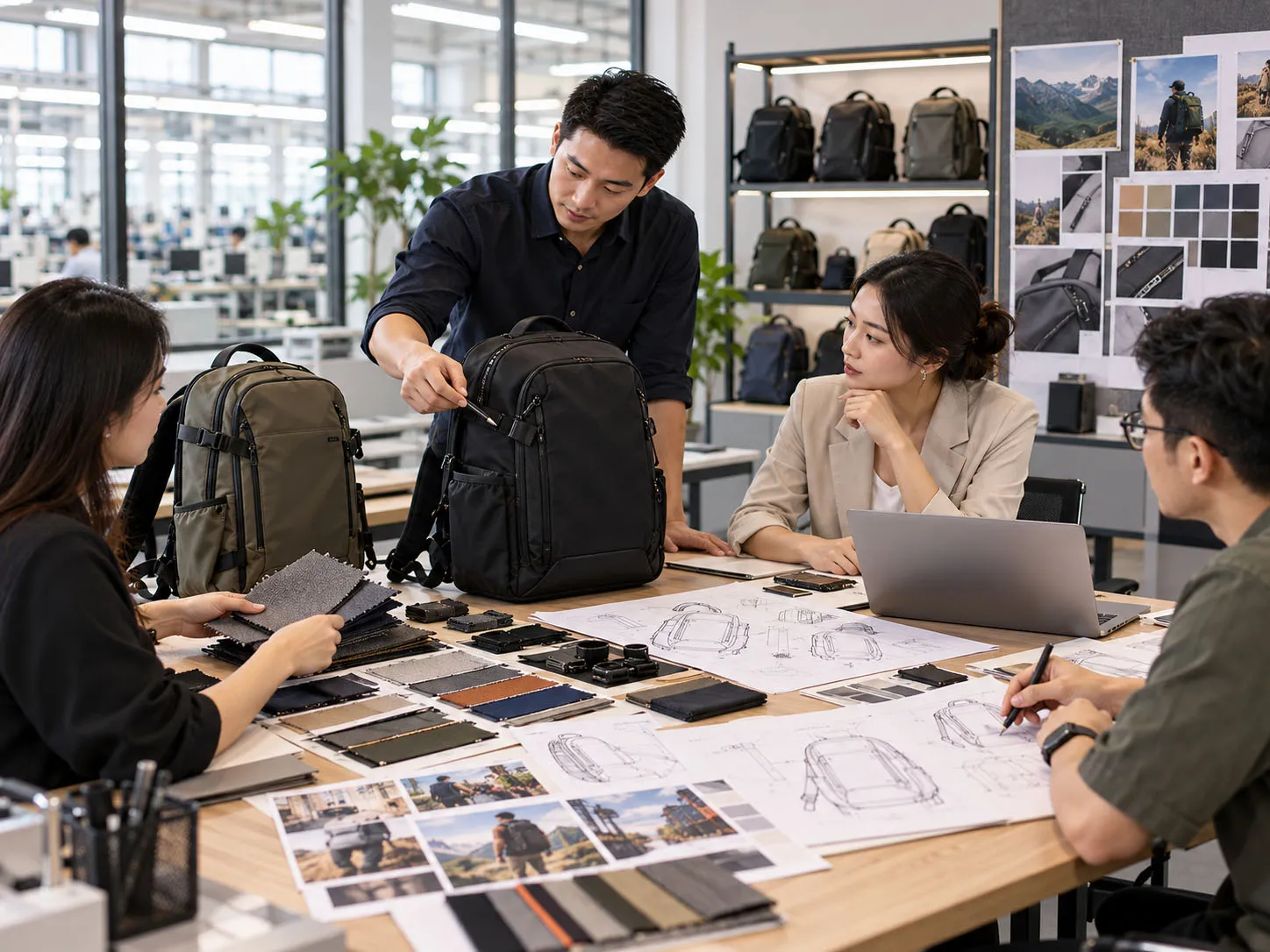
Customizing a backpack for your brand involves much more than adding a logo to an existing bag. From selecting fabrics and designing compartments to choosing zippers, developing samples, and managing bulk production, every decision affects the final product’s appearance, functionality, durability, and cost.
For brand owners, wholesalers, retailers, and corporate buyers, understanding the customization process is essential to developing backpacks that meet both customer expectations and commercial requirements.
Whether you’re launching a new backpack collection, expanding an existing product line, or sourcing promotional backpacks for your business, this guide explains how to customize a backpack step by step, including materials, branding methods, OEM/ODM manufacturing, sampling, minimum order quantities, quality control, and production.
How to Customize a Backpack: 7 Essential Steps
The backpack customization process typically involves seven key steps, from defining your product concept to approving bulk manufacturing.
Step 1: Define Your Backpack Style and Target Market
Before contacting a backpack manufacturer, identify the type of backpack you want to develop and who will use it.
Different backpack categories require different materials, structures, and functional features.
Common custom backpack styles include:
- Laptop backpacks: Designed with padded laptop compartments, organizational pockets, and protective construction.
- Travel backpacks: Built for luggage organization, comfortable carrying, and convenient access.
- Business backpacks: Focused on professional styling, structured silhouettes, and practical storage.
- Outdoor backpacks: Designed for durability, carrying comfort, and weather-resistant performance.
- School backpacks: Developed with suitable dimensions, comfortable straps, and everyday durability.
- Fashion backpacks: Focused on aesthetics, material combinations, colors, and brand identity.
For example, a business backpack may require a structured body, premium nylon fabric, padded laptop protection, and discreet logo placement.
An outdoor backpack may prioritize abrasion-resistant materials, reinforced stitching, adjustable straps, and water-resistant construction.
Defining your target customer helps determine which features are necessary and which would unnecessarily increase manufacturing costs.
Step 2: Choose Backpack Materials, Colors, and Hardware
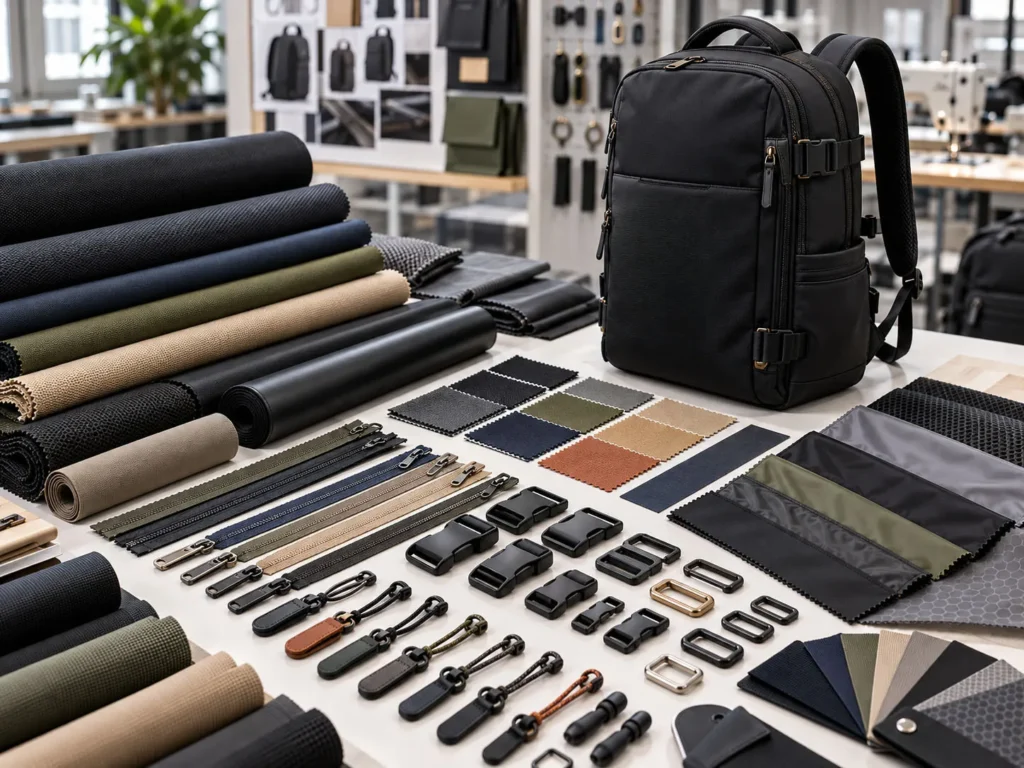
Material selection is one of the most important decisions in custom backpack development.
The fabric affects durability, weight, appearance, water resistance, manufacturing complexity, and price.
Common backpack materials include:
| Material | Key Characteristics | Typical Applications |
|---|---|---|
| Polyester | Cost-effective, versatile, available in many finishes | School, promotional, and everyday backpacks |
| Nylon | Strong, relatively lightweight, and abrasion-resistant | Travel, business, and outdoor backpacks |
| CORDURA® Fabric | Engineered textile options with durability characteristics that vary by specification | Premium outdoor and travel backpacks |
| Canvas | Textured appearance, available in different weights | Casual, lifestyle, and fashion backpacks |
| PU Leather | Leather-like appearance with various surface finishes | Fashion and business backpacks |
| Recycled Polyester | Can incorporate recycled polyester content | Sustainability-focused backpack collections |
Fabric specifications should include more than the material name.
For example, 600D polyester and 1680D nylon describe different yarn constructions, but denier alone does not establish overall fabric quality. Weave, coating, backing, tear strength, abrasion performance, and finishing also matter.
For better manufacturing consistency, brands should confirm:
- Fabric composition and construction
- Fabric weight and thickness
- Color references, such as Pantone codes
- Coating and water-resistance requirements
- Abrasion and tear-strength expectations
- Lining materials
- Zipper brands and specifications
- Buckles, adjusters, and other hardware
A professional backpack manufacturer can help evaluate material options based on your design, target price, and intended application.
Manufacturing Tip: Request physical fabric swatches before approving your sample. Colors and textures can look significantly different in photographs than they do in actual materials.
Step 3: Customize Backpack Compartments, Straps, and Features
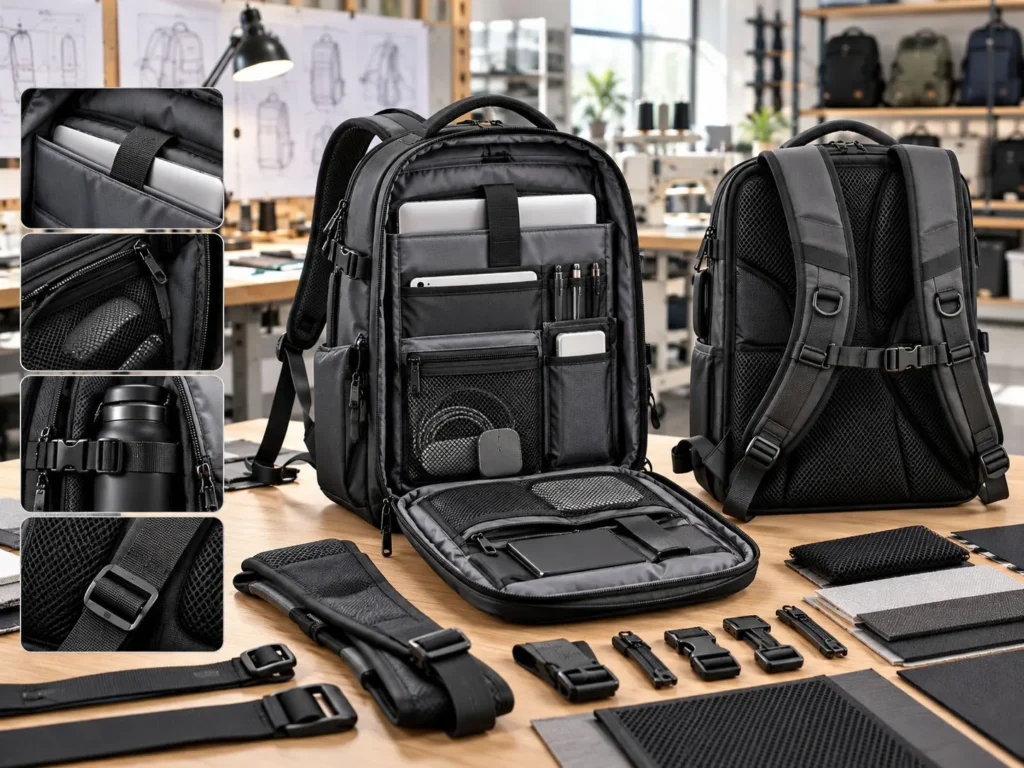
The internal structure and carrying system determine how useful and comfortable the finished backpack will be.
Brands can customize nearly every functional component, including:
Main compartments
Choose the number, dimensions, and opening styles of the main storage compartments. Options include top-loading, clamshell, roll-top, and multi-zipper constructions.
Laptop protection
Add padded laptop sleeves, suspended laptop compartments, protective foam, or dedicated tablet pockets.
Shoulder straps
Customize strap width, padding thickness, curvature, adjustability, and reinforcement.
Back panels
Options include padded mesh panels, ventilation channels, and structured support systems.
Storage organization
Add internal organizers, key holders, hidden pockets, bottle holders, charging-cable openings, or accessory compartments.
Special features
Depending on the intended market, backpacks may include luggage straps, reflective details, removable components, compression straps, or weather-protection features.
However, adding more features does not always produce a better backpack.
Each additional compartment, zipper, or reinforcement increases material consumption and assembly time.
For commercial production, the goal is to balance functionality, manufacturing feasibility, customer needs, and target cost.
Step 4: Select Your Logo and Branding Method
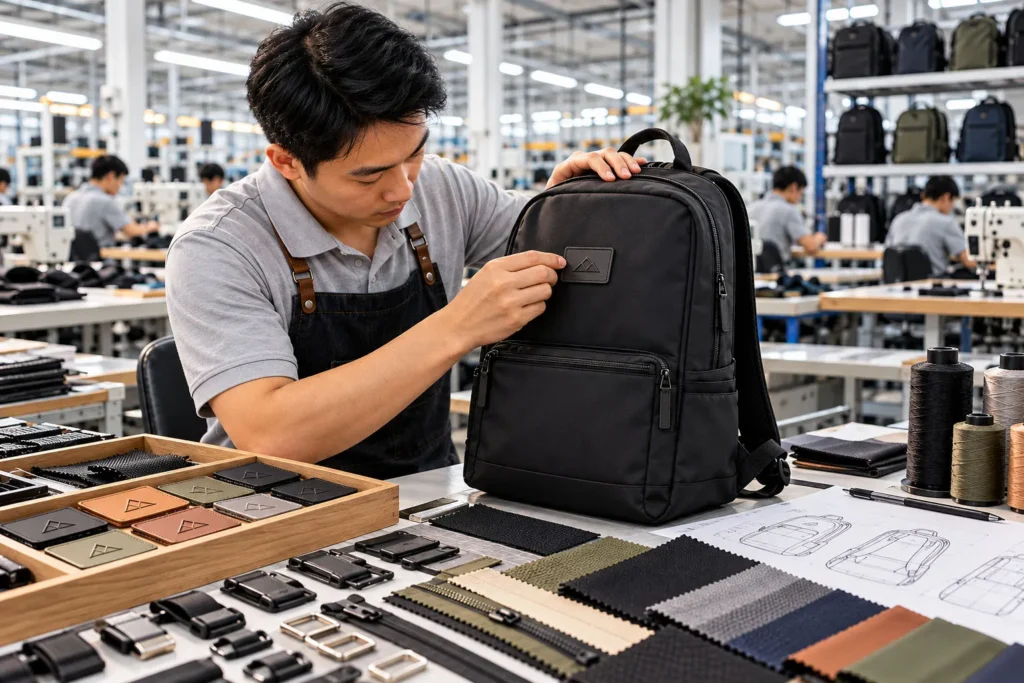
Branding is one of the most recognizable elements of a custom backpack.
The appropriate logo method depends on the fabric, brand positioning, design complexity, production quantity, and desired appearance.
| Branding Method | Advantages | Suitable Applications |
|---|---|---|
| Screen Printing | Effective for relatively simple designs and larger print areas | Promotional and casual backpacks |
| Embroidery | Textured, durable appearance | Business, school, and lifestyle backpacks |
| Heat Transfer | Supports detailed and multicolor artwork | Fashion and promotional backpacks |
| Woven Labels | Clean appearance with fine woven details | Private-label backpack collections |
| Rubber or Silicone Patches | Raised texture and distinctive branding | Outdoor and streetwear backpacks |
| Metal Logo Plates | Premium visual presentation | Business and fashion backpacks |
| Debossed Logos | Subtle branding on compatible materials | PU and leather-style backpacks |
For example, embroidery can work well on a business backpack, while a rubber patch may better suit an outdoor collection.
Logo placement is equally important.
Common positions include the front panel, upper pocket, shoulder strap, side panel, interior lining, and zipper puller.
Before production, provide editable vector artwork, preferably AI, EPS, or suitable PDF files.
The manufacturer should confirm logo dimensions, placement, colors, and production method during sample development.
Manufacturing Tip: Finalize logo placement before approving the backpack pattern. Seams, curved panels, padding, and zipper openings can restrict where a logo can be applied cleanly.
Step 5: Prepare Your Backpack Design Files and Tech Pack
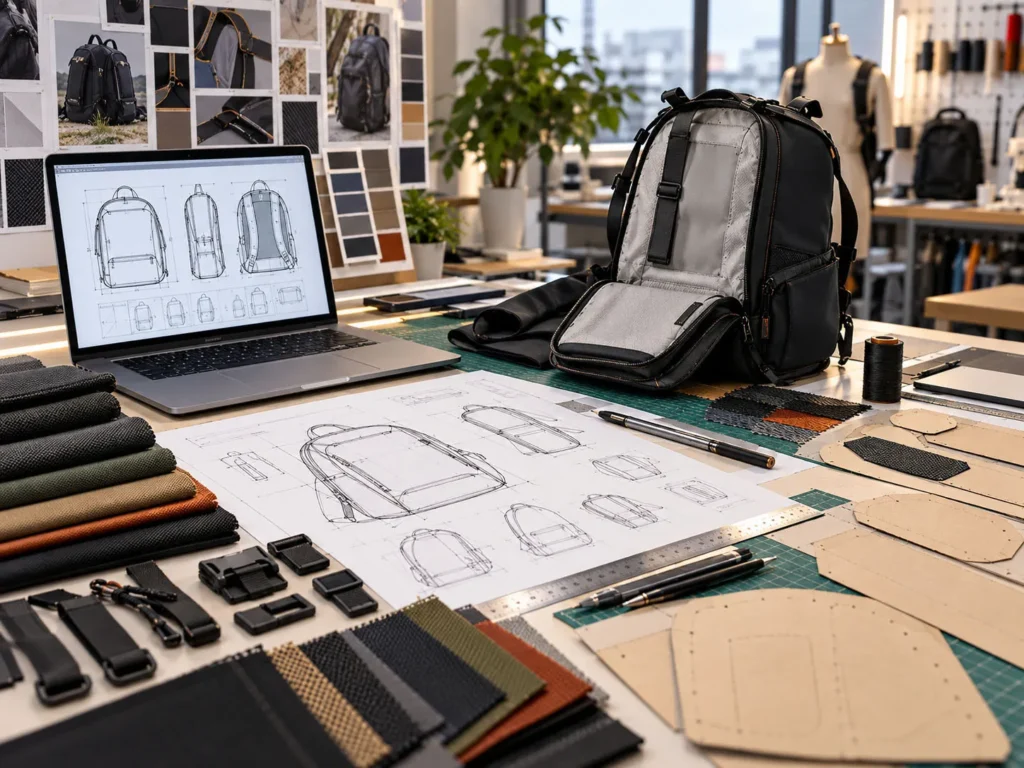
A technical specification package, commonly called a tech pack, helps translate your backpack concept into manufacturing instructions.
It reduces misunderstandings between the brand and the factory.
A complete backpack tech pack should include:
- Product sketches or reference images
- Overall dimensions and capacity targets
- Material and lining specifications
- Fabric and hardware color references
- Compartment dimensions and construction details
- Zipper, buckle, and webbing specifications
- Logo artwork, size, and placement
- Stitching and reinforcement requirements
- Labeling and packaging instructions
- Measurement tolerances
- Quality and testing requirements
You should also identify the document version and revision date.
This is particularly important when multiple sample revisions are involved.
For example, if you change a shoulder strap from 45 mm to 50 mm, that change should appear in the updated specification rather than remaining only in an email conversation.
What if you don’t have a complete tech pack?
You can still begin a development discussion with sketches, photographs, reference products, and a written feature list.
An experienced OEM/ODM backpack manufacturer can help evaluate feasibility and clarify the technical specifications needed before sampling.
However, the final manufacturing specification should be documented and approved before bulk production.
Step 6: Develop and Approve Your Custom Backpack Sample
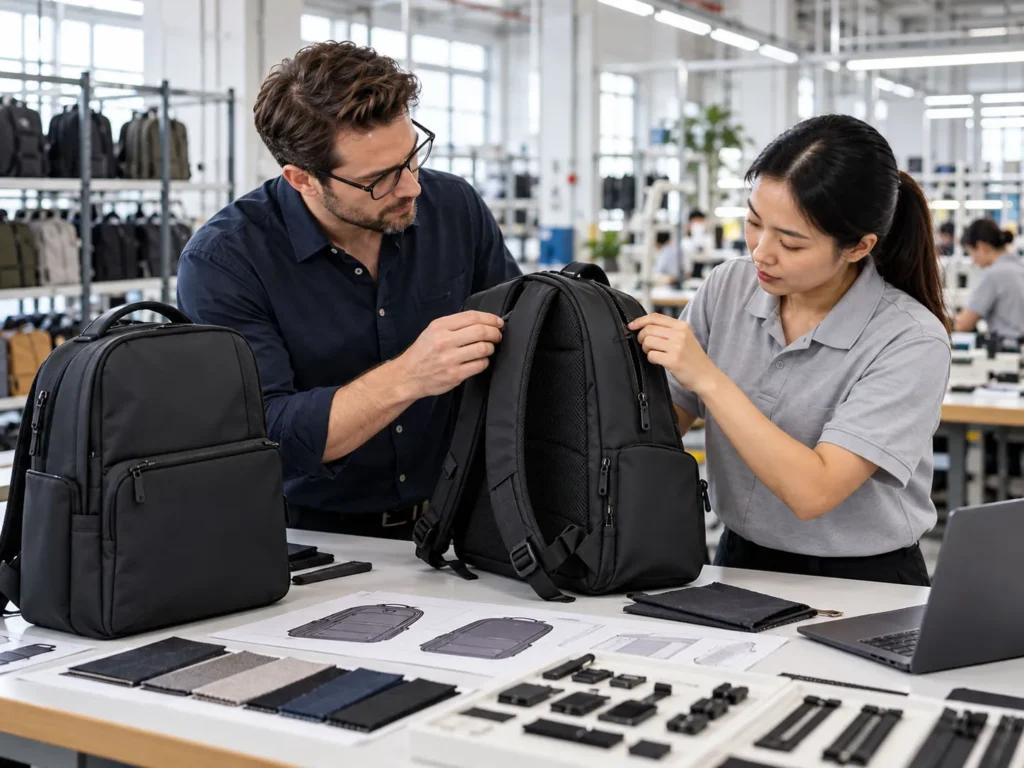
Sampling is where your backpack design becomes a physical product.
It allows you to evaluate materials, dimensions, functionality, construction, branding, and overall appearance before committing to a larger order.
The sampling process usually involves three stages.
1. Initial Development Sample
The manufacturer creates the first physical prototype based on your design and specifications.
At this stage, evaluate the backpack’s shape, compartment layout, carrying comfort, material selection, and construction.
2. Revised Sample
If changes are required, the factory adjusts the pattern, materials, dimensions, or functional features.
Some designs need only one revision, while more complex backpacks may require several rounds.
3. Pre-Production Sample (PP Sample)
The PP sample should represent the approved construction and intended bulk-production materials.
It serves as a physical reference for manufacturing and inspection.
Before approval, check:
- Overall dimensions and shape
- Fabric colors and material quality
- Logo accuracy and placement
- Zipper and buckle operation
- Shoulder strap construction
- Compartment functionality
- Stitching quality
- Packaging and labeling details
Once the sample meets your requirements, provide written approval identifying the approved sample and specification revision.
Important: Do not authorize bulk production based only on photographs or informal confirmation when critical specifications remain unresolved.
Step 7: Confirm Bulk Production and Quality Requirements
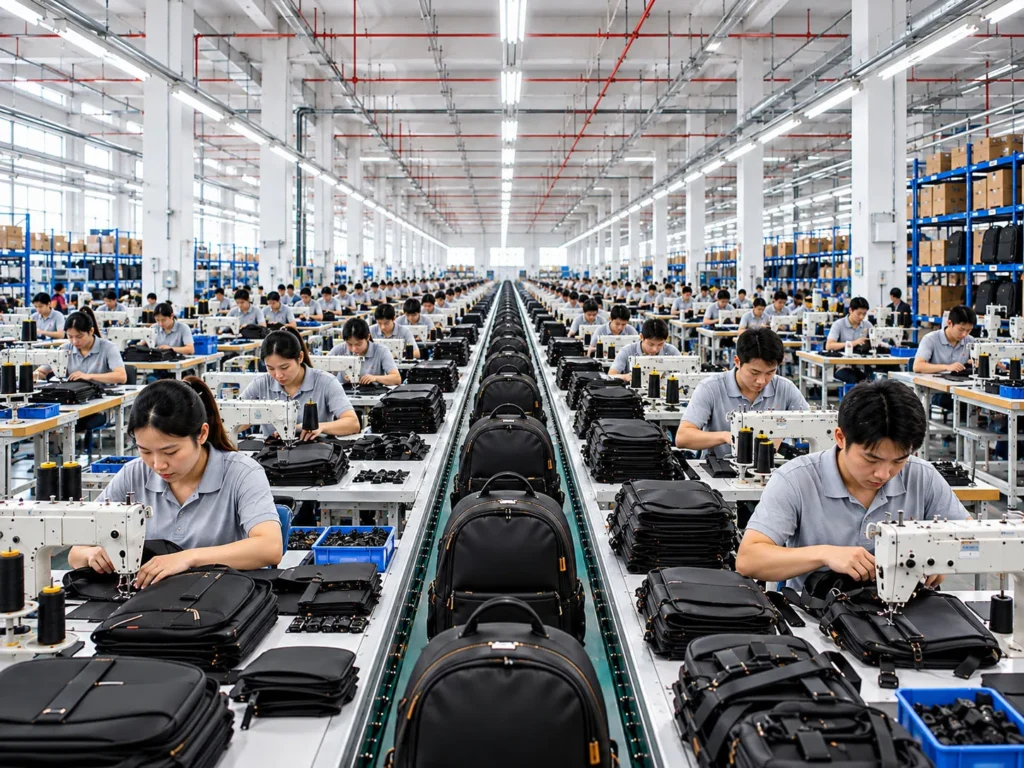
After sample approval, the manufacturer can prepare for bulk production.
The process generally includes material procurement, incoming inspection, cutting, sewing, assembly, finishing, final inspection, and packing.
A reliable production plan should confirm:
- Approved sample and technical specifications
- Final order quantity by style and color
- Material availability
- Production schedule
- Quality inspection requirements
- Packaging instructions
- Shipment arrangements
For brands developing a new product, a smaller initial production run may help evaluate customer response before scaling, provided the required materials and components can be sourced economically.
The key is to ensure that every production decision follows the approved specifications rather than assumptions made during manufacturing.
OEM vs. ODM Backpack Manufacturing: Which Is Better for Your Brand?
Understanding OEM and ODM manufacturing helps brands choose an appropriate development route.
What Is OEM Backpack Manufacturing?
OEM, or Original Equipment Manufacturing, generally refers to producing backpacks according to the buyer’s design and specifications.
The brand may provide original sketches, technical drawings, patterns, material requirements, and construction details.
OEM is particularly suitable for brands that want a distinctive product design or specific functional features.
Advantages include greater design flexibility and control over product specifications.
However, original development may require additional sampling, pattern development, tooling, and material sourcing.
What Is ODM Backpack Manufacturing?
ODM, or Original Design Manufacturing, generally involves adapting a manufacturer’s existing backpack design.
Brands may customize colors, fabrics, logos, labels, packaging, and selected functional details.
ODM can be useful for businesses seeking faster product development with fewer structural changes.
Because existing patterns or components may be available, some ODM projects can reduce development time and initial costs.
OEM vs. ODM Comparison
| Factor | OEM | ODM |
|---|---|---|
| Design foundation | Buyer’s original concept | Manufacturer’s existing design |
| Customization flexibility | Generally higher | Depends on existing design |
| Development time | Often longer | Potentially shorter |
| Sampling complexity | May be higher | Often lower for minor changes |
| Initial development cost | May be higher | Potentially lower |
| Suitable buyers | Brands developing distinctive products | Private-label and faster-launch programs |
Neither route automatically determines ownership of designs, patterns, or tooling.
Those rights should be established in a written manufacturing agreement.
For brands seeking custom development, Tamador provides backpack manufacturing services covering design discussions, material selection, sampling, branding, and bulk production.
How Much Does It Cost to Customize a Backpack?
The cost of a custom backpack depends on its materials, design complexity, branding requirements, order quantity, and manufacturing specifications.
There is no universal unit price because two backpacks with similar external appearances can have very different construction costs.
Main Factors Affecting Custom Backpack Costs
1. Materials
Premium fabrics, specialized coatings, branded zippers, and reinforced components generally cost more than standard materials.
2. Design complexity
A backpack with multiple compartments, curved panels, specialized padding, and complex construction usually requires more cutting and sewing operations.
3. Logo customization
Embroidery cost may depend on stitch count and size. Printing cost can depend on artwork complexity, colors, and setup requirements.
Custom metal or molded components may require additional tooling.
4. Order quantity
Larger orders can distribute certain setup and development costs across more units.
However, discounts depend on the actual cost structure and should not be assumed.
5. Packaging
Individual polybags, branded hangtags, custom boxes, and special carton requirements can affect the final quotation.
6. Quality and compliance requirements
Specialized material testing, third-party inspection, and market-specific compliance requirements may add costs.
How to Get an Accurate Backpack Manufacturing Quote
Instead of requesting a general price for a custom backpack, provide the manufacturer with:
- Backpack type and dimensions
- Reference images or technical drawings
- Preferred materials
- Logo method and artwork
- Estimated order quantity
- Number of colors
- Target market
- Packaging requirements
- Required testing or compliance standards
The more complete your specifications, the easier it is to compare quotations from different suppliers.
For international buyers, also clarify whether the quotation is EXW, FOB, or another agreed Incoterms basis.
A factory unit price is not the same as your final landed cost.
What Is the Minimum Order Quantity for Custom Backpacks?
MOQ stands for Minimum Order Quantity.
It represents the minimum number of backpacks a manufacturer or upstream supplier is willing to produce under a particular specification.
MOQ varies depending on the design, fabric, hardware, branding method, and production arrangement.
For example, a backpack made using stock fabrics and standard hardware may support a smaller production run than one requiring custom-dyed materials and specially manufactured components.
MOQ may also apply separately to each style, color, material, or component.
How Can Brands Reduce Custom Backpack MOQ?
If you are launching a new backpack brand, consider these approaches:
- Use available stock fabrics rather than custom-dyed materials.
- Select standard zipper sizes, buckles, and webbing.
- Reduce the number of initial colorways.
- Start with an existing backpack design when appropriate.
- Simplify unnecessary structural features.
- Discuss trial-order options with your manufacturer.
A lower MOQ is not always the most economical option.
Smaller orders can carry higher unit costs because setup, cutting preparation, sampling, and material procurement are spread across fewer pieces.
The best approach is to discuss your expected sales volume and target price with the manufacturer before finalizing the design.
How Long Does Custom Backpack Manufacturing Take?
Custom backpack production timelines vary according to design complexity, material availability, sample revisions, factory capacity, and shipping arrangements.
A typical project includes several stages.
| Production Stage | Planning Considerations |
|---|---|
| Design review and quotation | Depends on specification completeness |
| Initial sample development | Depends on construction complexity and available materials |
| Sample revisions | Depends on the number and scope of changes |
| PP sample approval | Requires final specification and material confirmation |
| Material procurement | May be longer for custom fabrics or hardware |
| Bulk manufacturing | Depends on quantity, complexity, and factory scheduling |
| Inspection and shipment | Depends on inspection results and logistics arrangements |
For a straightforward customization project using available materials, development may be considerably faster than for an entirely new backpack requiring custom patterns, molds, and specialized fabrics.
Brands should also allow time for approval decisions.
Delayed artwork confirmation, repeated design changes, or late material substitutions can affect the entire production schedule.
Manufacturing Tip: Request a written production timeline with key approval dates and shipment milestones before placing your order.
How Do Backpack Manufacturers Ensure Product Quality?
Quality control is essential for maintaining consistency between the approved sample and bulk production.
For custom backpacks, inspection should cover materials, construction, functionality, appearance, and packaging.
A practical quality management process includes three main stages.
1. Incoming Quality Control (IQC)
Before materials enter production, the factory checks incoming fabrics, zippers, webbing, buckles, lining, and other components against approved specifications.
Typical inspection points include material appearance, color consistency, dimensions, visible defects, and component functionality.
Where necessary, material properties should be verified through appropriate testing.
2. In-Process Quality Control (IPQC)
During cutting, sewing, and assembly, inspectors monitor production quality.
Common inspection points include:
- Cutting accuracy
- Seam alignment
- Stitch consistency
- Reinforcement locations
- Zipper installation
- Shoulder strap attachment
- Logo placement
- Overall construction
Identifying problems during production reduces the risk of repeating the same defect across an entire order.
3. Outgoing Quality Control (OQC)
Before shipment, finished backpacks are inspected against the approved specifications and reference sample.
Checks may include dimensions, appearance, stitching, zipper operation, compartment functionality, labeling, and packaging.
Brands may also request an independent final random inspection.
What Is AQL Inspection?
AQL stands for Acceptance Quality Limit.
It is used with a defined sampling plan to establish lot acceptance or rejection criteria.
For consumer products, buyers and inspection providers often use different acceptance levels for critical, major, and minor defects.
However, an AQL value is not a guarantee that the same percentage of products in a shipment will be defective.
The actual sample size and acceptance numbers depend on the selected standard, inspection level, lot size, and sampling plan.
Brands should agree on defect classifications, inspection methods, and acceptance criteria before production.
At Tamador, quality control is integrated into material inspection, production monitoring, and finished-product inspection to support consistent manufacturing.
What Compliance Requirements Should Custom Backpacks Meet?
Compliance requirements depend on the destination market, intended users, materials, and product claims.
For backpacks sold in the United States or Europe, brands should identify applicable requirements during product development rather than waiting until the shipment is ready.
United States
Depending on the product, relevant considerations may include:
- Country-of-origin marking
- Customs classification and applicable duties
- California Proposition 65 exposure and warning requirements
- Children’s product requirements when applicable
- Restricted substances and material safety
- Retailer-specific testing and packaging requirements
A backpack marketed primarily for children may be subject to additional children’s product rules. Requirements should be assessed according to the product’s intended age group, design, and applicable regulations.
European Union
Depending on the backpack’s materials and intended use, relevant considerations may include:
- REACH chemical restrictions
- General product safety obligations
- Product traceability and labeling
- Packaging requirements
- Additional requirements for specific product categories
A manufacturer can assist with material information, production documentation, and relevant testing arrangements, but the brand or importer should confirm its legal obligations in the destination market.
Important: Water-resistant, waterproof, recycled-content, and other performance or environmental claims should be supported by suitable specifications and evidence.
Common Mistakes to Avoid When Customizing Backpacks
Developing a custom backpack becomes easier when brands avoid several common sourcing mistakes.
1. Starting Without Clear Specifications
Reference photographs alone rarely communicate all the details required for consistent manufacturing.
Provide measurements, material requirements, construction details, and branding specifications whenever possible.
2. Choosing Materials Based Only on Price
A cheaper fabric may reduce the initial quotation but fail to deliver the desired durability, appearance, or customer experience.
Evaluate materials against the backpack’s intended use.
3. Adding Too Many Features
Extra pockets, zippers, and decorative elements increase manufacturing complexity.
Prioritize the features your target customers actually need.
4. Ignoring Sample Revisions
Small problems in the sample can become expensive problems in bulk production.
Document changes and verify that revised samples reflect the updated specifications.
5. Approving Bulk Production Too Early
Bulk manufacturing should begin only after the relevant sample, materials, artwork, and technical requirements have been approved.
6. Comparing Quotations Without Matching Specifications
Two factories may quote different prices because they are using different materials, hardware, padding, or construction methods.
Always compare quotations based on equivalent specifications.
7. Overlooking Quality Inspection
Agree on inspection requirements before production rather than discussing defects only after the shipment is completed.
Why Work with an Experienced Custom Backpack Manufacturer?
Choosing a manufacturing partner is about more than finding the lowest unit price.
An experienced manufacturer can help identify construction limitations, recommend appropriate materials, evaluate cost-saving alternatives, and develop samples that are suitable for repeatable production.
For brand owners and private-label buyers, useful capabilities include:
- OEM and ODM product development
- Material and hardware sourcing
- Pattern development and sampling
- Multiple logo customization methods
- Bulk manufacturing
- Quality inspection
- Custom labeling and packaging
- International shipment coordination
At Tamador International Limited, we support brands, wholesalers, importers, and distributors with custom bag manufacturing services.
Our development process focuses on turning product concepts into practical manufacturing specifications, followed by sampling, approval, production, and quality inspection.
Whether you are developing a business backpack, travel backpack, laptop backpack, or an original private-label collection, our team can discuss material options, branding requirements, construction details, and production feasibility.
The objective is to help buyers create backpacks that meet their design expectations while remaining practical for commercial manufacturing.
Ready to Customize Backpacks for Your Brand?
Have a backpack design, reference image, or product concept?
Tamador provides OEM and ODM backpack manufacturing services for brands, wholesalers, and commercial buyers.
Share your preferred backpack style, materials, logo requirements, estimated quantity, and target market with our team.
We can review your project requirements and discuss suitable development, sampling, and manufacturing options.
Request a Custom Backpack Quote or Start Your Backpack Project to discuss your requirements with our manufacturing team.
Frequently Asked Questions About Customizing Backpacks
1. Can I customize a backpack with my own logo?
Yes. Brands can customize backpacks using embroidery, screen printing, heat transfer, woven labels, rubber patches, metal logo plates, and other suitable branding methods. The best option depends on the material, logo design, desired appearance, and order quantity.
2. Can I design my own backpack from scratch?
Yes. OEM manufacturing allows brands to develop backpacks based on original concepts, sketches, reference products, and technical specifications. The manufacturer can help evaluate materials, construction, sampling requirements, and production feasibility.
3. What is the best material for a custom backpack?
The best material depends on the backpack’s intended application. Polyester is widely used for everyday and promotional backpacks, while nylon is often selected for travel and business applications. Canvas, PU, and specialized performance fabrics are also suitable for particular designs.
4. How much does it cost to make a custom backpack?
Custom backpack pricing depends on materials, size, construction complexity, hardware, logo methods, order quantity, and packaging. An accurate quotation requires a defined product specification and estimated production volume.
5. What is the minimum order quantity for custom backpacks?
MOQ varies by manufacturer, backpack design, fabric availability, and component requirements. Existing designs with stock materials may support smaller orders, while fully customized backpacks may require higher quantities. Confirm minimums by style and color before ordering.
6. How long does it take to make a custom backpack sample?
Sampling time depends on the design’s complexity, material availability, and development requirements. Simple modifications to an existing design may take less time than developing a new pattern and structure. Request a project-specific schedule from your manufacturer.
7. What is the difference between OEM and ODM backpacks?
OEM backpacks are manufactured according to buyer-defined designs and specifications. ODM backpacks generally begin with an existing manufacturer design that can be adapted through materials, colors, branding, and selected features.
8. Can I customize the compartments and size of a backpack?
Yes. Brands can customize dimensions, storage capacity, laptop compartments, internal pockets, shoulder straps, back panels, and other functional features. Structural changes may require new patterns and additional sampling.
9. How can I ensure the quality of custom backpacks?
Prepare clear specifications, approve a physical sample, confirm material requirements, and establish inspection criteria before production. Incoming material inspection, in-process checks, and final inspection help maintain consistency.
10. Can I order custom backpacks without a tech pack?
Yes. Some manufacturers can begin discussing your project using sketches, reference photographs, or a written description. However, a complete and approved technical specification should be developed before bulk production to reduce misunderstandings and quality risks.
Conclusion
Learning how to customize a backpack is the first step toward developing a product that represents your brand and meets your customers’ expectations.
Successful backpack customization involves more than selecting colors and adding a logo. It requires thoughtful material selection, functional design, clear technical specifications, careful sampling, and consistent manufacturing quality.
For brands entering the market, starting with a well-defined product concept and a reliable manufacturing partner can make the development process more efficient.
Before placing your first order, focus on five priorities: define your target customer, choose suitable materials, prepare clear specifications, approve your sample, and establish quality requirements.
With the right preparation and manufacturing support, your backpack concept can move from an initial idea to a production-ready product.
Looking for a custom backpack manufacturing partner?
Explore Tamador’s backpack manufacturing services and contact our team to discuss your design, sampling, and bulk production requirements.