
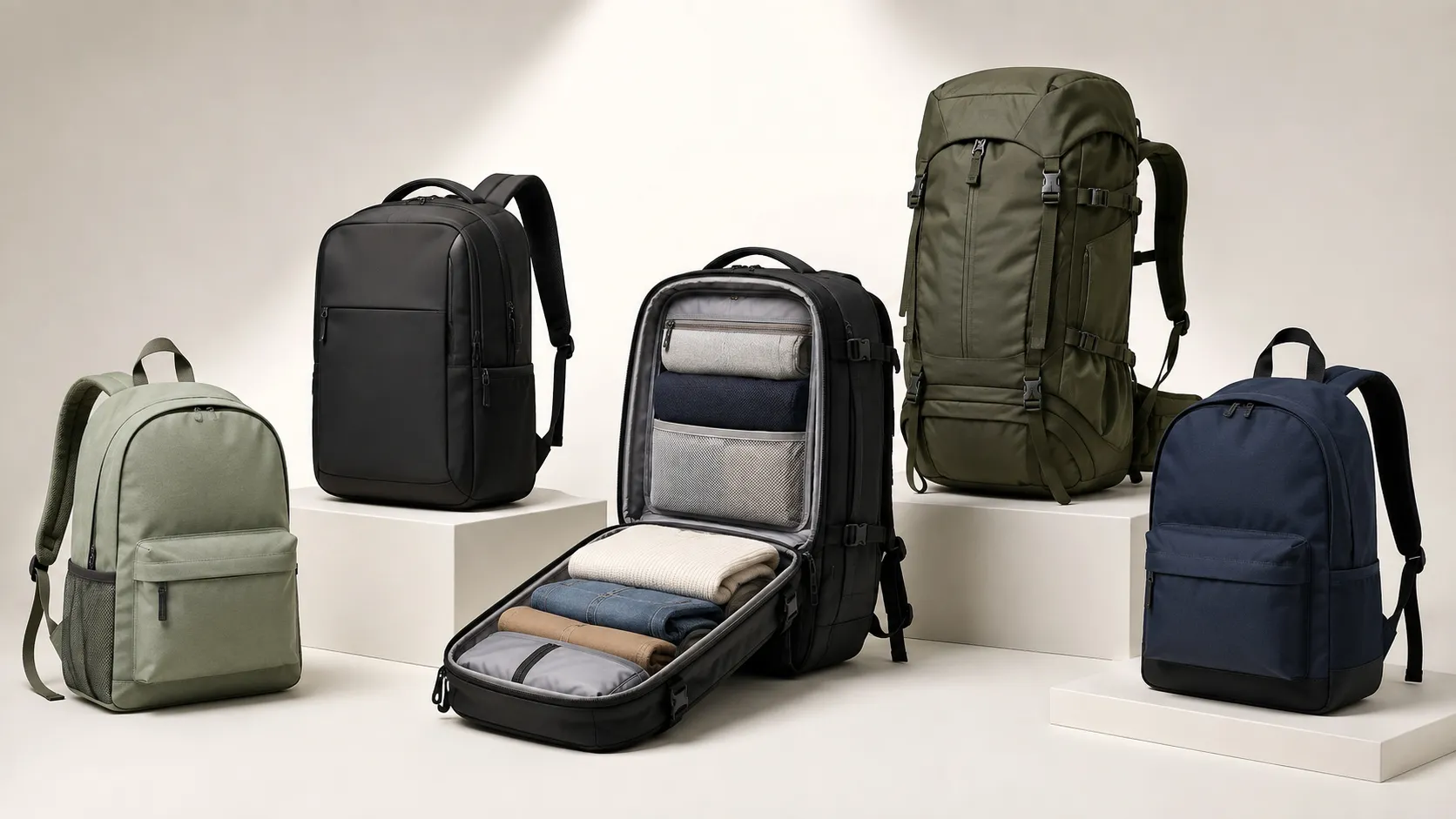
Choosing a backpack sounds simple until you start comparing dozens of styles, sizes, materials, and features.
Should you choose a daypack or a laptop backpack? Is a travel backpack better than a regular backpack for flying? How large should a hiking backpack be? And do you really need a different backpack for work, travel, and outdoor activities?
The right answer depends less on what looks impressive and more on what you carry, where you carry it, and how long you carry it.
This guide explains the main types of backpacks, what each one is best suited for, how backpack capacity affects usability, and which features matter most when choosing the right backpack.
Quick Backpack Comparison
| Backpack Type | Best For | Typical Capacity | Key Feature to Look For |
|---|---|---|---|
| Daypack | Daily essentials, errands, short outings | 10–30L | Lightweight construction and simple organization |
| Laptop / Commuter Backpack | Work, school, commuting | 15–35L | Padded laptop compartment and quick-access storage |
| Travel Backpack | Flights, carry-on trips, city travel | 30–45L | Clamshell opening and internal organization |
| Hiking Backpack | Day hikes and multi-day trekking | 15–80L | Load support, torso fit and hip belt |
| School Backpack | Books, lunch, tablets and laptops | 15–30L | Durability, padded straps and multiple compartments |
What Backpack Should You Choose?
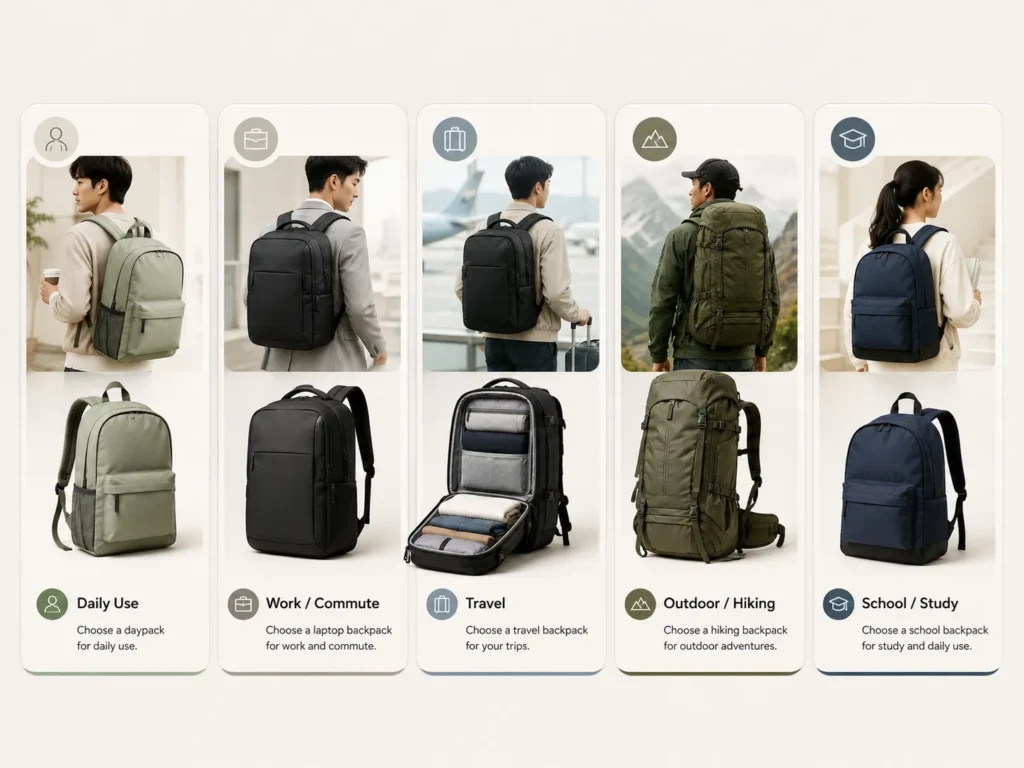
If you want the short answer, start with what you use the backpack for most often.
Choose a daypack if you mainly carry daily essentials and want something lightweight and easy to use.
Choose a laptop or commuter backpack if you regularly carry a computer, charger, documents, accessories and other work or school items.
Choose a travel backpack if you want suitcase-style packing, easy organization and enough capacity for short trips.
Choose a hiking backpack if you carry heavier loads over longer distances and need proper weight distribution and support.
Choose a school backpack if durability, organization and comfortable everyday carrying are the main priorities.
There is no single backpack that is perfect for everyone. The best backpack is the one that matches your normal routine rather than the largest or most feature-packed option available.
Start With Your Routine, Not the Backpack
Before comparing fabrics, zipper systems or hidden pockets, think about what actually goes inside your backpack on a normal day.
Do you carry a laptop, charger, notebook and headphones across the city?
Are you packing several days of clothes for a flight?
Do you carry water, food, extra clothing and outdoor equipment on a trail?
Or do you mainly need space for books, a lunch box and a tablet?
These questions matter because backpack design is closely connected to the load being carried.
A backpack that works perfectly for commuting may feel unnecessarily complicated for casual daily use. Likewise, a lightweight daypack may become uncomfortable if it is repeatedly loaded with heavy equipment.
Ask yourself three questions:
- What will I normally carry?
- How long will I carry the backpack at one time?
- How often do I need to access what is inside?
Once those answers are clear, choosing the right backpack becomes much easier.
The Main Types of Backpacks Explained
Daypack
A daypack is one of the simplest and most versatile backpack styles.
It is designed for short daily use and typically carries essentials such as a wallet, water bottle, light jacket, snacks, small electronics or personal items.
Most daypacks fall somewhere around 10–30 liters, although the exact size depends on the intended use.
A good daypack normally focuses on:
- Lightweight construction
- Simple organization
- Comfortable shoulder straps
- One main compartment
- A small number of quick-access pockets
Choose a daypack when you value simplicity and do not routinely carry heavy equipment.
It works particularly well for errands, casual outings, sightseeing and short daily trips.
If you regularly carry a full laptop setup, large books or heavier equipment, however, a commuter or laptop backpack will usually provide better organization and support.
Commuter or Laptop Backpack
A commuter backpack is designed around the needs of people who move between home, work, school, cafés and public transportation.
The defining feature is usually a dedicated padded laptop compartment.
Other common features include:
- Organizer pockets
- Charger and cable storage
- Document compartments
- Quick-access pockets
- Padded shoulder straps
- Breathable back panels
- Water-resistant fabrics
Typical commuter and laptop backpacks range from approximately 15–35 liters.
For most office workers, students and professionals, around 20–30 liters provides enough room for a laptop, charger, notebook, water bottle and a few personal items without becoming unnecessarily bulky.
For brands developing work-oriented backpacks, internal organization is particularly important because users increasingly expect technology storage, protection and quick access to be integrated into the design.
Tamador’s Laptop Backpack Manufacturer page explains the types of materials, laptop compartments, structures and customization options commonly used in OEM and ODM laptop backpack production.
Travel Backpack
Travel backpacks are designed around packing efficiency, mobility and organization.
Unlike many everyday backpacks, good travel backpacks often open widely rather than only from the top.
A common travel backpack feature is the clamshell opening, which allows the backpack to open much like a suitcase.
This makes clothing, packing cubes and travel accessories easier to organize.
Common travel backpack features include:
- 30–45L carry-on capacity
- Clamshell opening
- Compression straps
- Internal dividers
- Laptop compartment
- Hidden passport or valuables pockets
- Luggage straps
- Lockable zipper systems
For short flights and city travel, 30–45 liters is often the most practical range.
Larger travel backpacks can provide more storage, but they may no longer meet airline carry-on size requirements.
If you travel frequently, ease of opening can matter almost as much as capacity. A bag that allows you to reach clothing, electronics and documents without unpacking everything is much easier to live with on the road.
Brands developing this category can explore Tamador’s Travel Backpack Manufacturer page for OEM and ODM travel backpack structures, customization and production capabilities.
Hiking or Backpacking Backpack
Hiking backpacks are designed differently from most everyday backpacks because comfort under load becomes much more important.
Typical capacity varies significantly depending on the trip.
A rough guide is:
- 15–35L: day hikes
- 30–50L: overnight trips
- 40–60L: weekend trekking
- 50–80L+: multi-day backpacking
The most important difference is the carrying system.
A good hiking backpack may include:
- Padded hip belt
- Sternum strap
- Load-lifter straps
- Adjustable torso length
- Internal or external frame
- Ventilated back panel
- Compression straps
- Hydration compatibility
The purpose of these features is to distribute weight more effectively across the body instead of concentrating the entire load on the shoulders.
For hiking backpacks, fit is often more important than simply choosing the right number of liters.
A correctly fitted 50L backpack can feel more comfortable than a poorly fitted 35L backpack carrying the same weight.
School Backpack
School backpacks are designed for repeated everyday use.
Typical contents may include:
- Books
- Notebooks
- Lunch boxes
- Water bottles
- Tablets
- Laptops
- Chargers
- Stationery
Most school backpacks fall around 15–30 liters.
Because these bags are often used almost every day, durability matters.
Look for:
- Reinforced shoulder strap attachment points
- Strong stitching
- Durable bottom panels
- Padded back panels
- Comfortable shoulder straps
- Organized compartments
- Laptop or tablet protection
A school backpack should provide enough organization without adding unnecessary weight before anything is even placed inside.
Backpack Opening Styles Matter More Than You Might Think
Backpacks can serve a similar purpose while feeling completely different simply because of how they open.
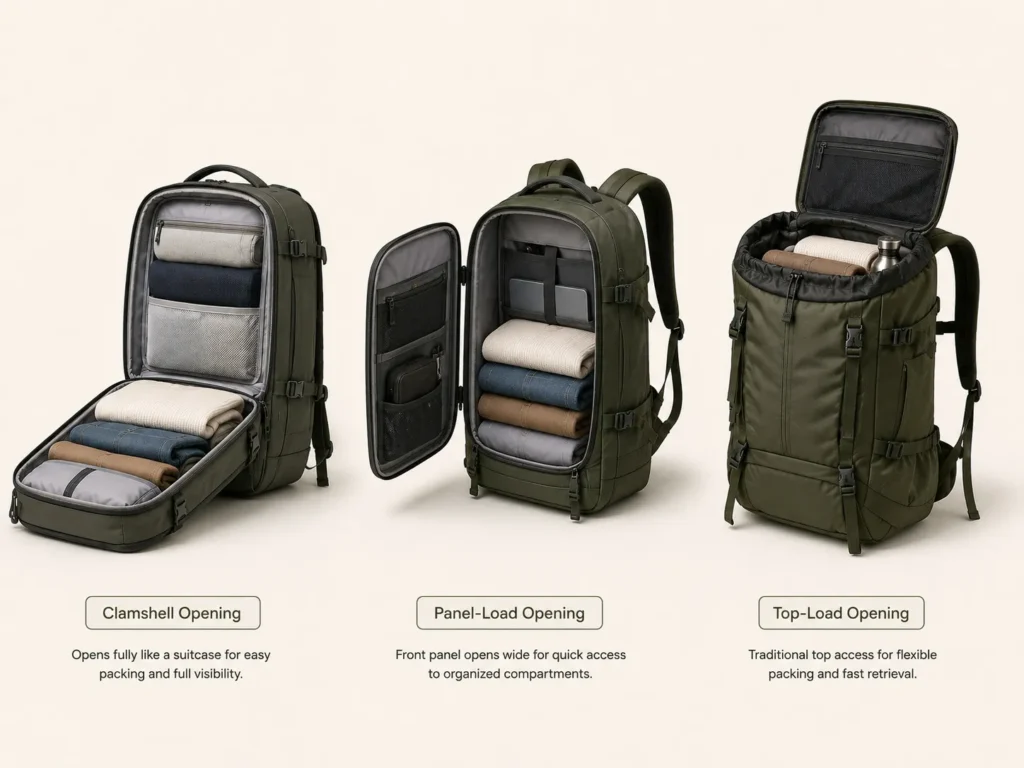
There are three particularly common opening styles.
Clamshell Opening
A clamshell backpack opens almost completely flat, similar to a suitcase.
This design is especially useful for:
- Travel
- Packing cubes
- Clothing
- Organized storage
The major advantage is visibility. You can see almost everything inside the bag at once.
The downside is that opening the entire backpack may be inconvenient when you only need to quickly retrieve one small item.
Panel-Loading Backpack
A panel-loading backpack uses a large zipper opening across part of the front or upper section of the backpack.
It provides wider access than a traditional top-loading design without opening completely like a suitcase.
Panel-loading designs are commonly found in:
- Commuter backpacks
- Laptop backpacks
- School backpacks
- Everyday backpacks
For many users, this design provides a good balance between accessibility and structure.
Top-Loading Backpack
Top-loading backpacks open from the upper part of the bag and commonly use a drawstring, roll-top or flap closure.
They are frequently seen in outdoor and hiking designs.
Advantages include:
- Simple construction
- Efficient use of vertical space
- Good compression
- Potentially better weather protection
- Reduced zipper dependency
The main disadvantage is accessibility.
Items packed near the bottom may require removing everything above them first.
If you constantly need quick access to multiple items throughout the day, a panel or clamshell opening may be more practical.
What Backpack Size Do You Need?
Backpack capacity is usually measured in liters.
However, choosing the largest capacity is rarely the best approach.
A useful general guide is:
| Capacity | Typical Use |
|---|---|
| Under 15L | Minimal daily essentials |
| 15–25L | Daily commuting, school and casual use |
| 20–30L | Laptop carry, work and versatile daily use |
| 30–45L | Carry-on travel and short trips |
| 40–60L | Weekend hiking and longer travel |
| 50–80L+ | Multi-day trekking and expedition use |
For daily use, 18–25 liters is enough for many people.
For travel, 30–45 liters provides more flexibility while remaining manageable.
For hiking, capacity should depend heavily on trip duration and the equipment being carried.
Remember that a larger backpack is not automatically more useful.
Extra capacity often encourages overpacking, which increases weight and reduces carrying comfort.
Comfort and Fit Should Come Before Extra Features
A backpack may have dozens of useful features, but none of them matter much if the bag is uncomfortable.
Pay particular attention to:
Shoulder Straps
Good shoulder straps should distribute pressure rather than cutting into the shoulders.
Padding should be firm enough to provide support without becoming unnecessarily thick.
Back Panel
A padded back panel improves comfort and can help prevent hard objects from pressing against the body.
Ventilated mesh can also reduce heat buildup during longer periods of use.
Sternum Strap
A sternum strap helps stabilize shoulder straps and prevents the backpack from shifting excessively while walking.
Hip Belt
Hip belts become more important as loads become heavier.
A properly designed hip belt transfers part of the backpack’s weight from the shoulders toward the hips.
This is particularly important for hiking and trekking backpacks.
Backpack Materials and Durability
Backpack type tells you what the bag is designed to do.
Materials help determine how well it will perform over time.
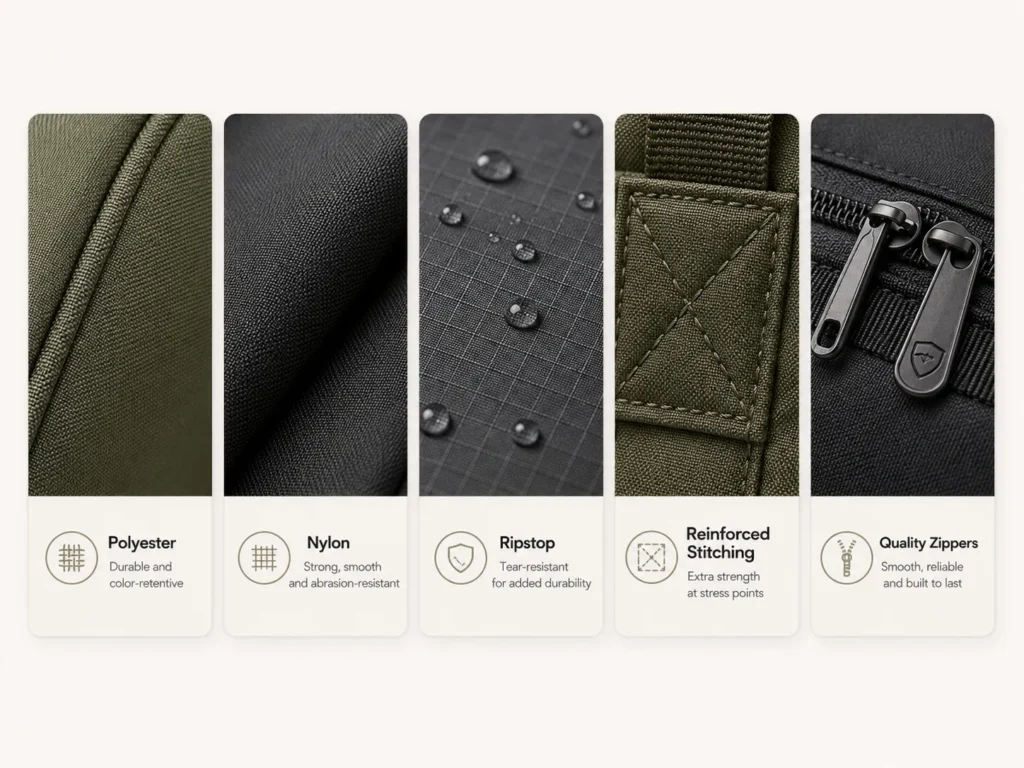
Common backpack fabrics include:
Polyester
Polyester is widely used because it is economical, durable and available in many weights, textures and finishes.
It works particularly well for:
- School backpacks
- Promotional backpacks
- Everyday backpacks
- Entry-level travel bags
Nylon
Nylon generally provides excellent abrasion resistance while remaining relatively lightweight.
It is commonly used for:
- Travel backpacks
- Laptop backpacks
- Outdoor backpacks
- Technical bags
Ripstop Fabric
Ripstop fabrics include reinforced yarns woven into the material to help limit tearing.
They are often used for outdoor and lightweight backpack designs.
Ballistic Nylon
Ballistic nylon is a heavier, abrasion-resistant fabric often used in premium travel, tactical and business-oriented bags.
TPU or PVC-Coated Fabrics
For backpacks requiring stronger water resistance, coated fabrics such as TPU or PVC may be used together with welded or sealed construction techniques.
Brands developing bags for wet environments can learn more from Tamador’s Waterproof Backpack Manufacturer page.
But fabric alone does not determine durability.
A strong backpack also requires:
- Reinforced stitching
- Proper seam construction
- Reliable zippers
- Strong webbing
- Reinforced stress points
- Secure shoulder strap attachment
A premium fabric can still fail if the construction around high-stress areas is weak.
What Features Are Actually Worth Having?
Backpack features should solve real problems rather than simply increase the specification list.
Useful features may include:
- Padded laptop compartments
- Water bottle pockets
- Hidden valuables pockets
- Compression straps
- Quick-access storage
- Luggage sleeves
- Adjustable sternum straps
- Internal organizers
- Key clips
- Cable storage
- Reflective details
But more features are not always better.
Every extra zipper, compartment, buckle or layer of fabric can increase weight, production complexity and cost.
A good backpack design balances function with simplicity.
Can One Backpack Do Everything?
Sometimes.
A versatile 20–30L backpack can handle commuting, casual daily use and occasional weekend travel reasonably well.
However, very different activities usually benefit from specialized designs.
For example, a hiking backpack requires load-support features that would feel excessive on a simple city commuter bag.
Similarly, a professional laptop backpack may offer excellent organization but lack the large opening and packing efficiency of a travel backpack.
If you regularly switch between very different activities, owning more than one backpack may provide a better experience than forcing one design to perform every task.
What Should Brands Consider When Designing a Backpack?
For brands, retailers and sourcing teams, choosing the right backpack design involves a different set of decisions.
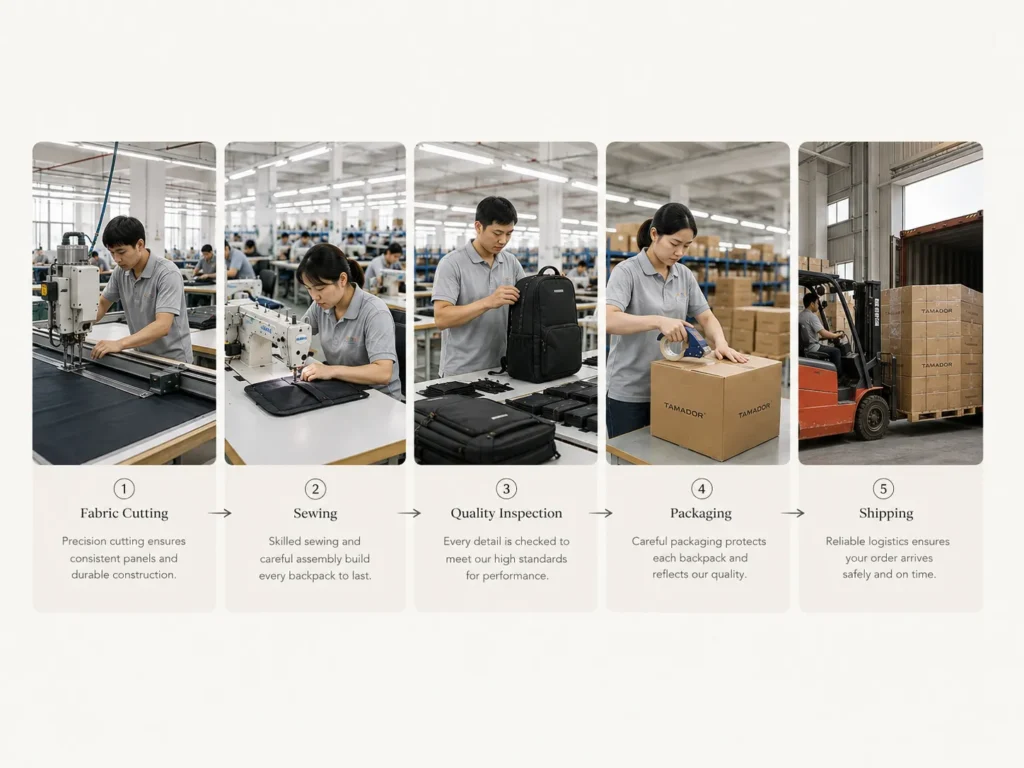
The starting point should still be the intended user.
Before developing a product, clarify:
- Who will use the backpack?
- What will they normally carry?
- How large should the backpack be?
- How long will users carry it?
- Does the product need water resistance?
- Does it need laptop protection?
- What opening style is most appropriate?
- What price range is the product targeting?
- Which materials fit the intended market?
- Which areas require reinforcement?
These decisions affect everything from pattern development and materials to hardware selection and manufacturing cost.
For example, a premium commuter backpack may prioritize clean appearance, laptop protection and internal organization, while a travel backpack may prioritize capacity, clamshell access and compression.
A professional Backpack Manufacturer can help translate these product requirements into workable materials, structures, samples and production specifications.
For projects requiring more extensive design changes, branding, materials, hardware or structural customization, brands can also explore Tamador’s Custom Backpack Manufacturer services.
Frequently Asked Questions
What size backpack do I need?
For most daily use and commuting, around 18–25 liters is sufficient.
For short travel, around 30–45 liters is common.
For multi-day trekking, 50 liters or more may be required depending on equipment, climate and trip duration.
Choose capacity based on what you genuinely carry rather than buying extra space “just in case.”
What backpack is best for everyday use?
A lightweight daypack or commuter backpack between approximately 15–25 liters works well for most everyday situations.
If you regularly carry a laptop, choose a backpack with a dedicated padded laptop compartment.
What backpack is best for travel?
For carry-on travel, a 30–45L clamshell travel backpack is one of the most practical options.
It provides enough capacity for clothing and electronics while offering easier packing than many traditional top-loading backpacks.
Can I use a laptop backpack for travel?
Yes.
For short trips, a larger laptop backpack can work very well, particularly if it includes good organization and enough space for clothing.
For longer trips, a dedicated travel backpack usually provides better packing access and capacity.
What’s the difference between a daypack and a hiking backpack?
A daypack is generally a lightweight, simple backpack intended for daily or short-duration use.
A hiking backpack usually includes more advanced carrying features such as hip belts, sternum straps, load lifters and structured back support.
Should I buy one backpack for everything?
If your needs are relatively similar, one versatile backpack may be enough.
But if you frequently alternate between office commuting, air travel and serious hiking, separate backpacks designed for each activity will usually perform better.
What backpack material lasts the longest?
There is no single material that is always best.
High-quality nylon, ballistic nylon, Cordura-style materials and strong coated fabrics can all provide excellent durability.
Construction quality, stitching, reinforcement and hardware are just as important as the fabric itself.
Final Thoughts: Choose the Backpack Around the User
The best backpack is not necessarily the largest, toughest or most expensive one.
It is the backpack that matches the user’s actual routine.
Start with what you carry, then consider capacity, comfort, opening style, organization, materials and durability.
For everyday use, simplicity may be most important.
For commuting, laptop protection and organization matter more.
For travel, access and packing efficiency become priorities.
For hiking, fit and load distribution should come first.
And for brands developing a new backpack collection, these same decisions form the foundation of good product development.
Tamador provides OEM and ODM backpack manufacturing for global brands, wholesalers and retailers, covering design development, materials, sampling, customization and bulk production.
You can explore our Backpack Manufacturing Services or Custom Backpack Manufacturing Solutions if you’re planning a new backpack project.