
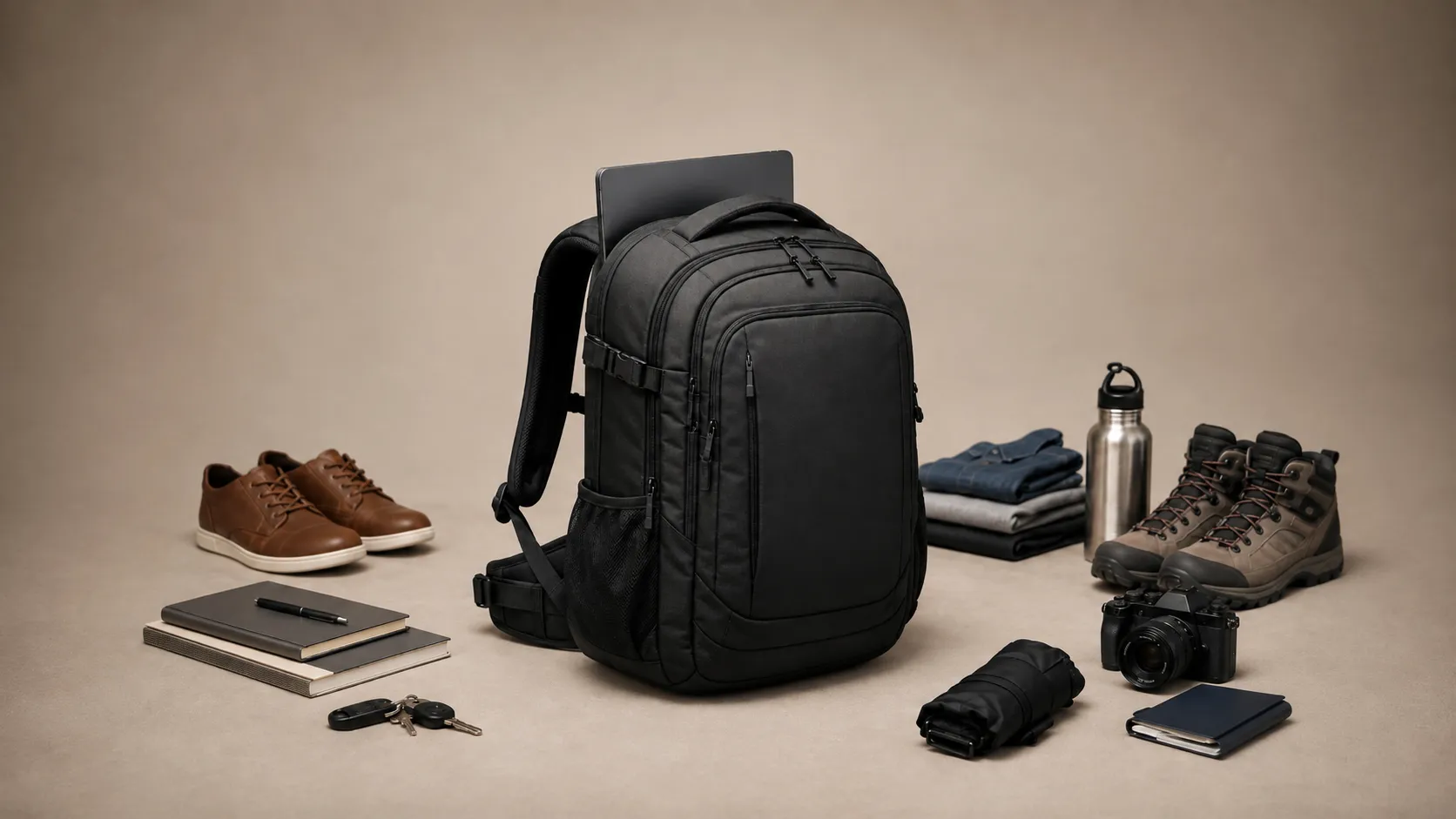
Search for the “best backpack” and you will find a different winner on almost every website.
One list recommends a rugged travel backpack. Another prefers a sleek commuter pack. A third argues that a lightweight hiking backpack is the better choice.
The reason is simple: there is no single best backpack for everyone.
The best backpack is the one that fits your body, carries what you actually need, and matches the way you use it most often.
Instead of looking for one universal winner, this guide explains how to evaluate backpack capacity, fit, comfort, opening style, materials, organization, and intended use so you can identify the best backpack for your own needs.
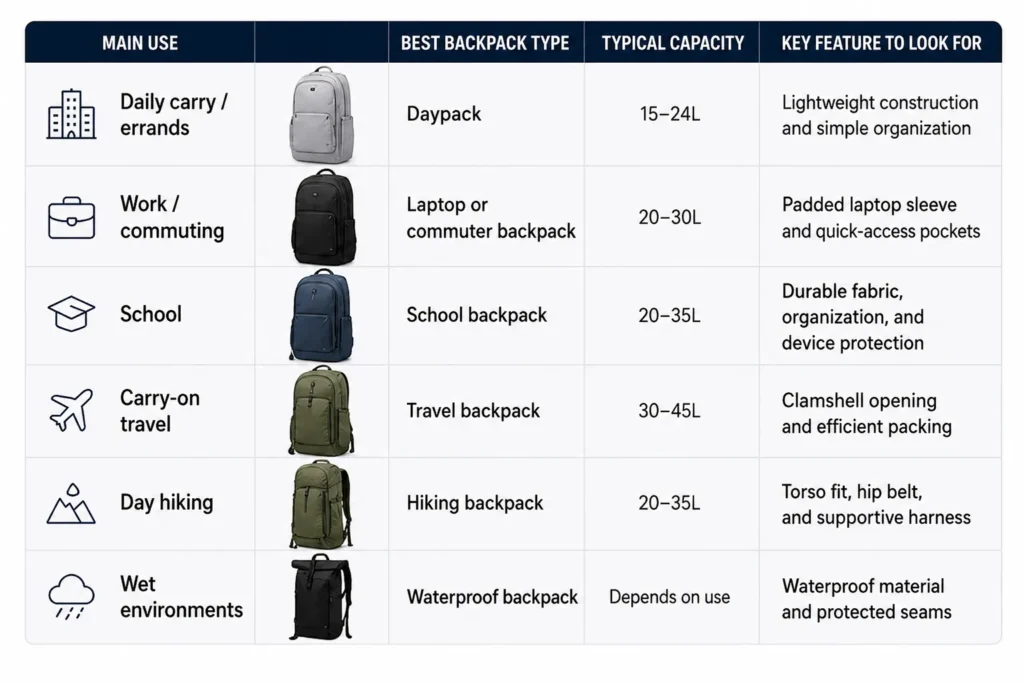
Quick Guide: The Best Backpack for Different Uses
| Main Use | Best Backpack Type | Typical Capacity | Key Feature to Look For |
|---|---|---|---|
| Daily carry / errands | Daypack | 15–24L | Lightweight construction and simple organization |
| Work / commuting | Laptop or commuter backpack | 20–30L | Padded laptop sleeve and quick-access pockets |
| School | School backpack | 20–35L | Durable fabric, organization, and device protection |
| Carry-on travel | Travel backpack | 30–45L | Clamshell opening and efficient packing |
| Day hiking | Hiking backpack | 20–35L | Torso fit, hip belt, and supportive harness |
| Multi-day hiking | Backpacking pack | 45–70L+ | Load support and adjustable suspension |
| Wet environments | Waterproof backpack | Depends on use | Waterproof material and protected seams |
What Is the Best Backpack?
The best backpack is one that matches your primary use, fits your body comfortably, carries your normal load without unnecessary bulk, and uses materials and features appropriate for where and how often you carry it.
For someone commuting to work every day, the best backpack may be a 20–30L laptop backpack with organized compartments and quick-access storage.
For a traveler, it may be a 30–45L clamshell backpack that opens like a suitcase.
For a hiker, comfort, torso fit, weight distribution, and weather resistance may matter more than laptop storage or office-style organization.
So rather than asking:
“What is the best backpack?”
A more useful question is:
“What is the best backpack for the way I actually use it?”
That distinction makes choosing much easier.
Start With Your Needs, Not the Shelf
Before comparing brands, fabrics, zippers, or extra pockets, think about what you normally carry.
Do you take a laptop, charger, documents, headphones, and water bottle to work?
Do you carry books and a tablet around campus?
Are you packing several days of clothing into an airline carry-on?
Or are you carrying water, food, extra layers, and outdoor equipment along a trail?
Your typical load should determine the backpack—not the other way around.
Ask yourself three questions:
- What do I normally carry?
- How long will I wear the backpack?
- How often do I need to reach what is inside?
A backpack that feels perfect for a short commute may become uncomfortable after several hours of walking.
Likewise, a large hiking backpack may offer excellent load support but feel unnecessarily bulky for everyday city use.
Start with the job the backpack needs to perform.
Capacity: Match the Backpack to What You Carry
Backpack capacity is usually measured in liters, and it is one of the easiest ways to narrow your choices.
A general guide is:
| Capacity | Typical Use |
|---|---|
| Under 15L | Minimal daily essentials |
| 15–24L | Daypacks and light everyday carry |
| 20–30L | Commuting, work, school, laptop carry |
| 30–45L | Carry-on travel and short trips |
| 40–60L | Weekend hiking and longer travel |
| 50–80L+ | Multi-day trekking and backpacking |
For most commuters, students, and everyday users, 20–30 liters is a useful range.
It provides enough room for common items without creating unnecessary bulk.
For travel, 30–45 liters is popular because it offers significantly more packing space while remaining manageable.
Hiking capacity depends more heavily on trip duration, equipment, climate, food, and water requirements.
The important principle is simple:
Do not buy the largest backpack you can carry. Buy the smallest backpack that comfortably carries what you genuinely need.
Oversized backpacks encourage overpacking, increase weight, and can make everyday use less convenient.
Fit: Size the Backpack to Your Body
Capacity tells you how much a backpack carries.
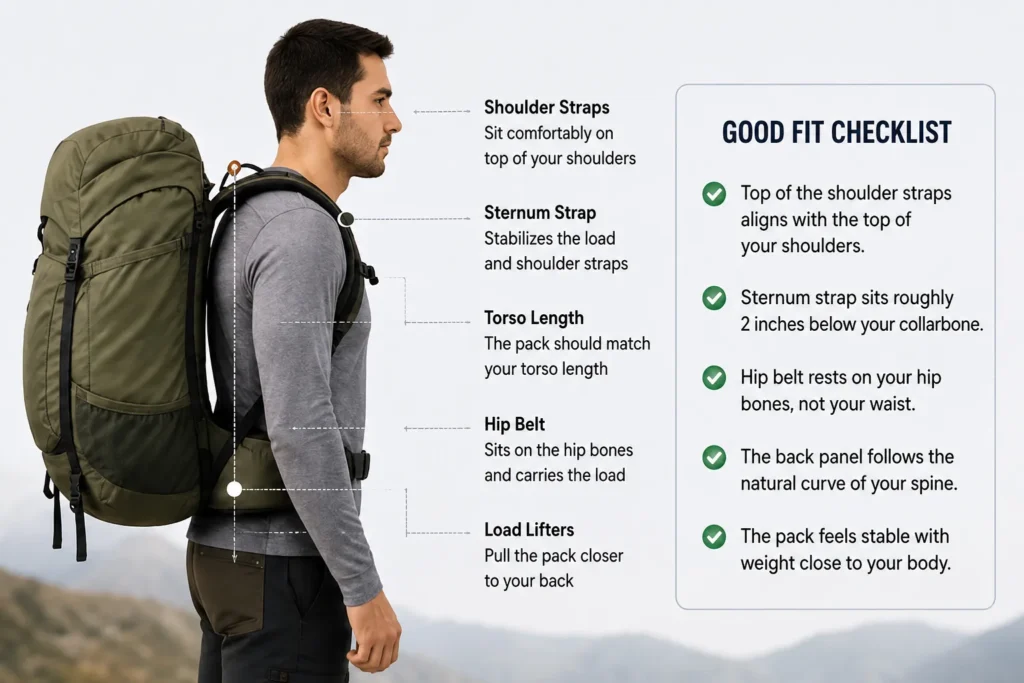
Fit determines how comfortable that load feels.
This becomes particularly important for hiking, travel, and heavier loads.
For technical backpacks, torso length is often more useful than a person’s overall height because two people of the same height can have very different torso proportions.
A backpack designed for heavier loads should sit securely against the back rather than hanging away from the body.
Important fit elements include:
- Shoulder strap position
- Back-panel length
- Sternum strap adjustment
- Hip-belt position
- Load-lifter angle
- Overall stability
For heavier backpacks, the hip belt should sit correctly around the upper hips so part of the load transfers away from the shoulders.
A poorly fitted backpack can feel heavy even when the actual load is reasonable.
A properly fitted backpack distributes the same weight more efficiently and feels more stable while moving.
Comfort and Support Features
The best backpack should remain comfortable for the amount of time you normally carry it.
For everyday backpacks, look for:
- Padded shoulder straps
- A comfortable back panel
- Balanced weight distribution
- Appropriate bag weight
- Breathable materials where useful
For heavier loads, additional support becomes more important.
These may include:
Sternum Strap
A sternum strap helps stabilize the shoulder straps and reduce side-to-side movement.
Hip Belt
A good hip belt transfers part of the load toward the hips rather than leaving all the weight on the shoulders.
Load Lifters
Load-lifter straps help pull the upper portion of a hiking backpack closer to the body.
Structured Back Panel
A structured or framed back panel can help control heavier loads and improve weight distribution.
These features are valuable when they solve a real carrying problem.
For a lightweight 15L everyday backpack, however, a complex suspension system would add unnecessary weight and bulk.
Opening Style: How You Access Your Backpack
How a backpack opens can have a surprisingly large effect on everyday usability.
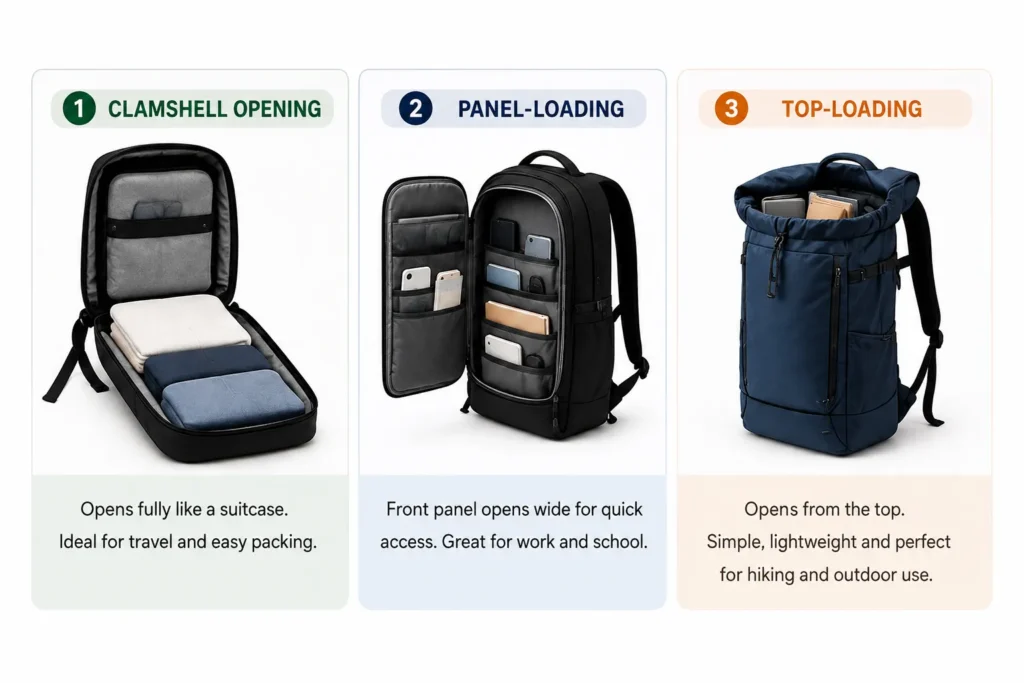
The three most common designs are clamshell, panel-loading, and top-loading.
Clamshell Opening
A clamshell backpack opens almost completely flat like a suitcase.
It works especially well for:
- Air travel
- Packing cubes
- Clothing
- Organized packing
- Longer trips
The biggest advantage is visibility.
You can see and reach most of the contents without digging through the bag.
For travelers, this is often one of the most useful backpack designs.
Brands developing this type of product can explore Tamador’s Travel Backpack Manufacturer capabilities for travel-focused structures, compartments, materials, and OEM/ODM customization.
Panel-Loading Backpack
A panel-loading backpack uses a large zipper opening across the front or upper section.
It provides good access without opening completely like a suitcase.
This design is especially common in:
- Laptop backpacks
- Commuter backpacks
- School backpacks
- Everyday backpacks
For work and daily use, panel-loading designs often provide a good balance between structure and quick access.
For brands developing work-focused bags, Tamador’s Laptop Backpack Manufacturer page covers laptop protection, internal organization, materials, and customization options.
Top-Loading Backpack
Top-loading backpacks open from the upper part of the bag.
They may use:
- Drawstrings
- Roll-top closures
- Flaps
- Buckles
- Zippers
Top-loading construction is commonly associated with outdoor and hiking backpacks.
Advantages can include:
- Simple construction
- Good vertical packing
- Reduced zipper dependency
- Easy compression
- Potential weather resistance
The trade-off is accessibility.
Items packed near the bottom can be harder to reach.
Organization: More Pockets Are Not Always Better
A good backpack should make frequently used items easy to reach.
But more compartments do not automatically make a backpack better.
Useful organization may include:
- Dedicated laptop sleeves
- Tablet compartments
- Water bottle pockets
- Internal zipper pockets
- Key clips
- Organizer pockets
- Hidden valuables compartments
- Cable storage
- Quick-access pockets
The best organization depends on what the backpack is designed to carry.
A commuter backpack benefits from structured compartments for electronics, documents, and accessories.
A hiking backpack may prioritize hydration storage, external attachment points, and larger open compartments.
A travel backpack often benefits from large packing areas combined with several smaller organizational sections.
The best designs give important items a logical place without making the backpack unnecessarily complicated.
Materials and Durability
Backpack materials affect weight, appearance, abrasion resistance, water resistance, cost, and lifespan.
Common backpack materials include:
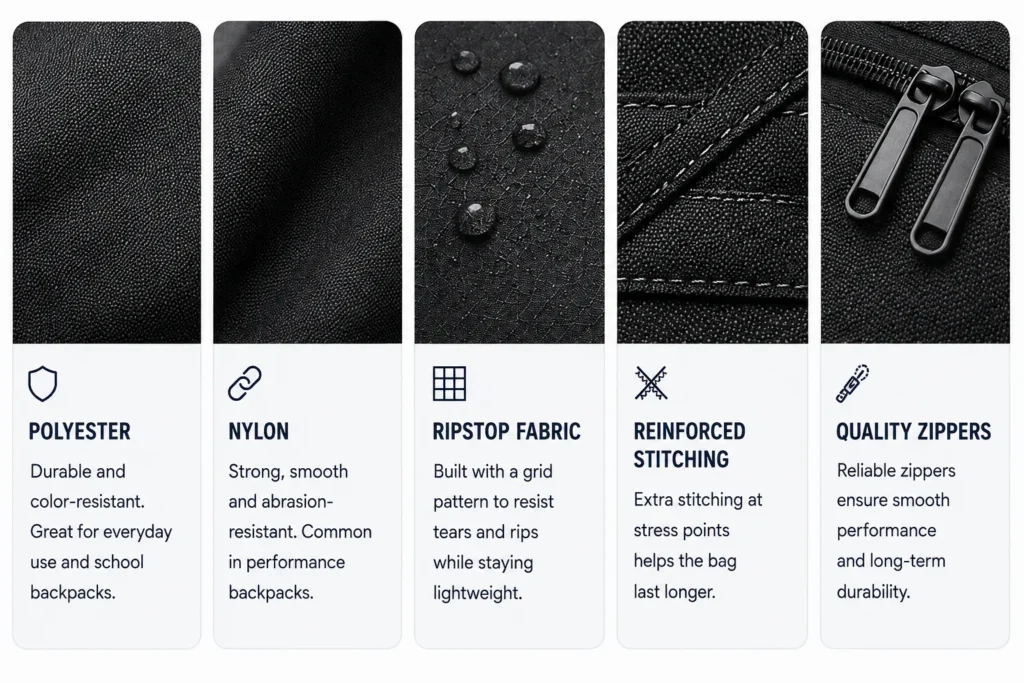
Polyester
Polyester is widely used for everyday, school, promotional, and commercial backpacks.
Advantages include:
- Good durability
- Wide range of weights and textures
- Good color stability
- Cost efficiency
Nylon
Nylon is commonly used for higher-performance backpacks because it combines relatively low weight with good abrasion resistance.
It is frequently used in:
- Travel backpacks
- Outdoor backpacks
- Laptop bags
- Technical backpacks
Ripstop Fabric
Ripstop materials use reinforced yarn patterns designed to help prevent small tears from spreading.
They are commonly used in outdoor and lightweight products.
Ballistic Nylon
Ballistic nylon is heavier and highly abrasion-resistant.
It is often used for premium business, tactical, and travel bags.
Coated and Waterproof Fabrics
Backpacks intended for wet environments may use materials with TPU, PU, or PVC coatings.
Construction is equally important because waterproof fabric alone does not automatically make an entire backpack waterproof.
Seams, zippers, openings, and construction methods also influence water resistance.
Brands developing products for wet conditions can explore Tamador’s Waterproof Backpack Manufacturer services.
Construction Quality Matters as Much as Fabric
A backpack made from excellent fabric can still fail if the construction is weak.
Pay attention to:
- Reinforced shoulder-strap attachment points
- Strong stitching
- Appropriate seam construction
- Reliable zippers
- Durable buckles
- Strong webbing
- Reinforced bottom panels
- Secure handles
High-stress areas deserve particular attention.
Shoulder straps, handles, zipper ends, and load-bearing seams are common failure points.
This is why the “best backpack” should not be judged by fabric specifications alone.
Materials and construction need to work together.
What Is the Best Backpack for Everyday Use?
For most people, the best everyday backpack is a 15–25L daypack or commuter backpack.
Look for:
- Low overall weight
- Comfortable straps
- Simple organization
- Water bottle storage
- Quick-access pockets
- Durable everyday fabric
If you regularly carry a laptop, choose a dedicated laptop or commuter backpack rather than a basic daypack.
What Is the Best Backpack for Work?
For office and commuting use, a 20–30L laptop backpack is usually the most practical choice.
Important features include:
- Padded laptop protection
- Document storage
- Organizer pockets
- Comfortable shoulder straps
- Professional appearance
- Quick-access compartments
- Water-resistant materials
The best work backpack should organize electronics without looking unnecessarily bulky.
What Is the Best Backpack for Travel?
For many travelers, the best travel backpack is a 30–45L clamshell backpack.
This size provides useful packing capacity while still being manageable for flights, trains, and city travel.
Useful travel features include:
- Clamshell opening
- Compression straps
- Internal organization
- Laptop storage
- Hidden valuables pockets
- Luggage pass-through
- Lockable zipper pulls
Airline carry-on limits vary, so external backpack dimensions should always be checked before flying.
What Is the Best Backpack for Hiking?
The best hiking backpack depends heavily on trip duration.
For a day hike, 20–35L is often sufficient.
For overnight or multi-day trips, larger capacities may be necessary.
More important than capacity alone are:
- Torso fit
- Hip belt
- Sternum strap
- Load lifters
- Ventilated back system
- Compression straps
- Appropriate frame structure
- Weather resistance
For hiking, comfort under load should take priority over extra compartments or appearance.
What Is the Best Backpack for School?
A good school backpack should balance durability, organization, and comfort.
For most students, approximately 20–35L provides enough room for books, notebooks, lunch, and electronics.
Look for:
- Reinforced shoulder straps
- Padded back panel
- Laptop or tablet sleeve
- Multiple compartments
- Durable bottom construction
- Water bottle pockets
Because school backpacks are used repeatedly, durability at stress points is especially important.
What Is the Best Backpack for Rainy Conditions?
If the backpack will regularly be used in wet conditions, water resistance should become a primary design consideration.
Look for:
- Coated fabrics
- Water-resistant or waterproof zippers
- Protected openings
- Sealed or welded seams where appropriate
- Roll-top or protected closure designs
It is important to distinguish between water-resistant and waterproof backpacks.
A water-resistant backpack can protect against light rain or splashes.
A genuinely waterproof backpack requires a more complete combination of materials, seams, closures, and construction methods.
Matching the Features to the Right Backpack Type
Once you understand your needs, capacity, fit, comfort, opening style, organization, and materials, choosing the right backpack type becomes much easier.
In general:
- Daily essentials → Daypack
- Office and commuting → Laptop / commuter backpack
- Flights and trips → Travel backpack
- Hiking and trekking → Hiking backpack
- Students → School backpack
- Wet environments → Waterproof backpack
The goal is not to choose the backpack with the longest feature list.
It is to choose the backpack whose features match your actual routine.
What Should Brands Consider When Developing a Better Backpack?
The same factors consumers use to judge a good backpack—fit, capacity, materials, organization, accessibility, comfort, and durability—are also the starting point for brands developing a new backpack collection.
Before manufacturing begins, brands should clearly define:
- Target users
- Intended use
- Required capacity
- Expected load
- Opening style
- Internal organization
- Material requirements
- Water resistance
- Comfort system
- Hardware
- Target cost
- Retail positioning
These decisions affect pattern development, construction methods, materials, labor, sampling, testing, and final production cost.
A professional Backpack Manufacturer can help translate these requirements into workable structures, specifications, samples, and production solutions.
For projects requiring deeper customization—such as custom dimensions, special compartments, private-label branding, material development, hardware, or structural changes—brands can explore Tamador’s Custom Backpack Manufacturer capabilities.
Frequently Asked Questions
What is the best backpack overall?
There is no single best backpack for everyone.
The best backpack is one that matches your main use, fits your body, carries your normal load comfortably, and provides the organization and durability you genuinely need.
What size backpack do I need?
For everyday use, approximately 15–25L works for many people.
For work and commuting, 20–30L is common.
For carry-on travel, approximately 30–45L is popular.
For multi-day hiking, 45L or more may be needed depending on the equipment and trip duration.
What is the best backpack for everyday use?
A lightweight 15–25L daypack or commuter backpack is usually a good choice.
If you regularly carry a laptop, choose a model with a padded laptop compartment.
What is the best backpack for travel?
A 30–45L clamshell backpack is one of the most practical choices for many carry-on travelers because it combines useful capacity with suitcase-style access.
What is the best backpack opening style?
It depends on how you use the bag.
Clamshell openings are excellent for travel.
Panel-loading backpacks work well for commuting, work, and school.
Top-loading designs are commonly suited to hiking and outdoor use.
Does backpack material matter?
Yes.
Materials influence weight, abrasion resistance, appearance, water resistance, and durability.
However, construction quality, stitching, hardware, and reinforcement are equally important.
Can one backpack work for everything?
A versatile 20–30L backpack can handle everyday use, commuting, and occasional short travel.
But specialized activities such as multi-day hiking usually benefit from a backpack designed specifically for that purpose.
Final Thoughts: The Best Backpack Depends on the User
The best backpack is not necessarily the most expensive, largest, toughest, or most feature-packed option.
It is the backpack that performs the job you actually need it to do.
Start with your main use.
Then evaluate:
Capacity → Fit → Comfort → Opening Style → Organization → Materials → Durability
For commuting, organization and laptop protection may matter most.
For travel, packing access and capacity become more important.
For hiking, fit and load distribution take priority.
And for brands developing backpack products, these same principles form the foundation of better product design.
Tamador provides OEM and ODM backpack manufacturing for brands, wholesalers, importers, and retailers, covering product development, materials, sampling, customization, quality control, and bulk production.
Explore Tamador’s Backpack Manufacturing Services or Custom Backpack Manufacturing Solutions if you are developing your next backpack collection.